How to Start Amazon KDP in 2027: A Beginner's Step-by-Step Guide
Starting Amazon KDP from zero in 2027: pick the right type of book, prove a topic sells with BSR, find your angle, create the book with AI the right way, publish, get honest reviews, market it and scale. Updated for Kindle+, the 2-books-a-week limit and AI disclosure.
If you were starting Amazon KDP from zero today, what would you actually do first? That's the question behind a popular beginner tutorial, How to Start Amazon KDP in 2026 by Sean Dollwet (October 2026). He has published on KDP for over ten years.
This guide follows the same five-step road map, updated for what's different going into 2027. It adds our own numbers, so you can check each step with a calculator instead of guessing.
The short version:
- Find a book idea people already buy. Check the BSR of books on the topic before you write anything.
- Create the book with your own unique angle, using AI as a tool, then edit and fact-check it.
- Publish on KDP. It's free. Disclose AI content when you upload.
- Market it. Get 5–10 honest reviews first, then add Amazon ads or social media.
- Scale. Add formats (ebook, paperback, hardcover, audiobook), translations, and then your next book.
What's new for 2027:
- KDP allows at most 2 new titles per format per week.
- Kindle Unlimited is now Kindle+ and includes audiobooks.
- The 70% ebook royalty covers prices up to $12.99.
- Free AI translation and AI narration options exist.
Why KDP is still a good first business
The video's reasons hold up in 2027:
- No inventory. Paperbacks and hardcovers are printed when someone orders.
- Amazon handles the hard parts: payments, printing, shipping, customer service and refunds.
- Built-in shoppers. Millions of people search Amazon for books every day. Most other online businesses have to find every customer themselves.
- Cheap to start. Publishing is free. Your costs are creating the book and some marketing.
- Books compound. A good book can keep selling for months or years while you write the next one.
The video is also honest about the downside: results aren't guaranteed. Big monthly incomes aren't typical, and anyone promising easy money is overselling it. KDP is a real business that takes work.
Pick the right type of book
There are three broad types:
| Type | Examples | Effort | Good first book? |
|---|---|---|---|
| High content | Non-fiction guides, fiction | Most work | Yes, if you follow a process |
| Medium content | Puzzle, activity, coloring, trivia books | Moderate | Yes, a good balance |
| Low content | Journals, planners, notebooks | Least work | Usually not; very hard to stand out |
The video recommends starting with medium or high content. You don't need to be an expert for many of these: a trivia book or a coloring book doesn't need a degree. For non-fiction, the value often comes from organizing information clearly and saving the reader time, not from saying something no one has said before.
For price planning: a 120-page puzzle book at $9.99 earns about $3.55 per paperback sale; the same book at $14.99 earns about $6.55. Below $9.99, US paperbacks drop to a 50% royalty rate, so check the paperback royalty calculator before you set a price.
Step 1: Prove the topic sells
- Brain-dump topics. List your hobbies, your job, things you're curious about, and problems you've solved.
- Search each one on Amazon in the Books department.
- Check the Best Sellers Rank (BSR) of the books on page one. It's on every product page under "Product details". A lower number means more sales.
- Look for a pattern. One hit book can be a fluke. Several books on the same topic selling well means the topic has demand.
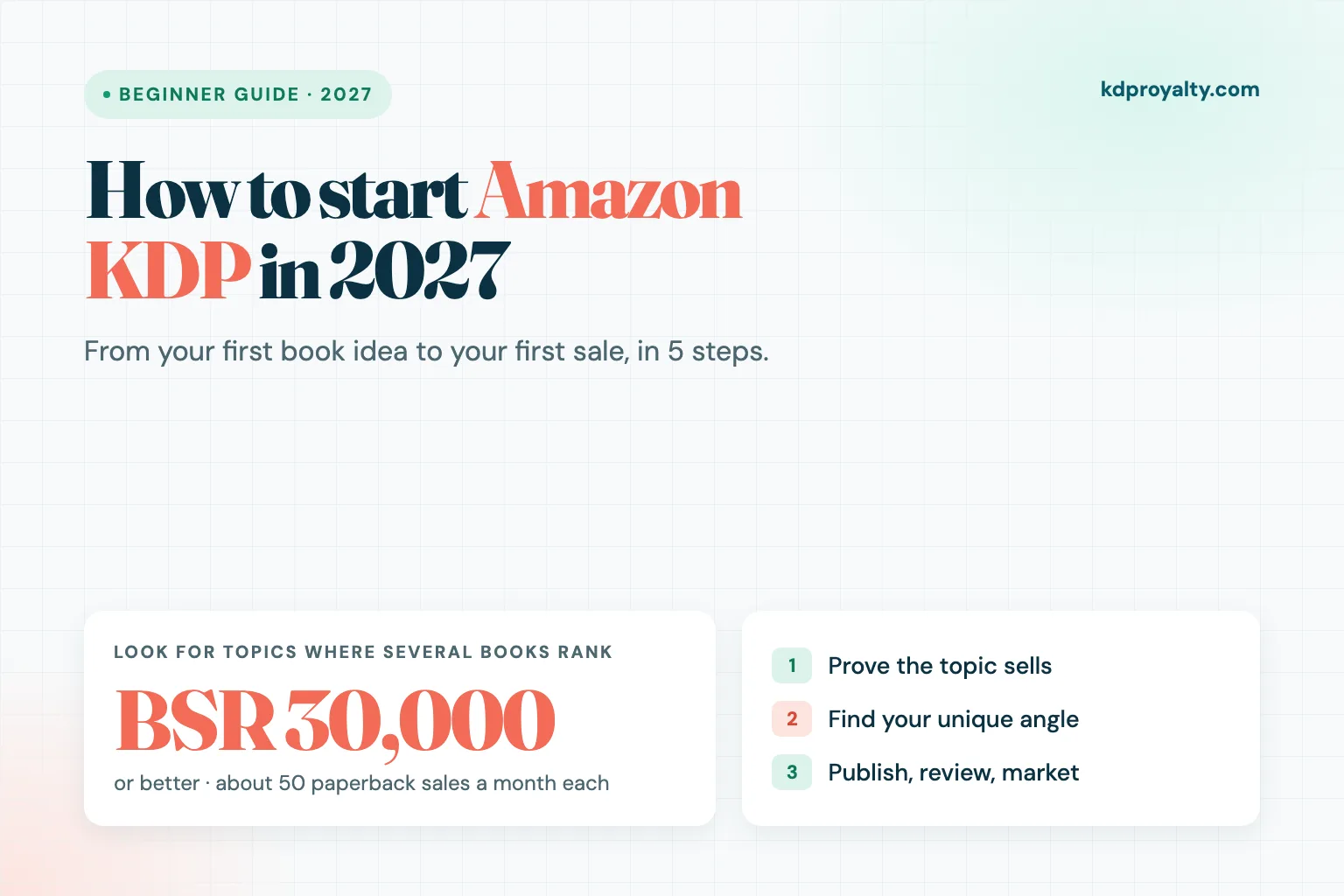
The video uses BSR 80,000 as its benchmark and says a book at that rank makes around $500 a month. Our calculator is more cautious: at 80,000 it estimates about 25 paperback sales a month. For a $14.99 paperback that's around $160 in royalties, or roughly $290 if the ebook ranks there too. If you want a topic where a single book can reach $500+ a month, look for several books at around 30,000 or better.
The exact numbers vary by category and season, so use BSR to compare topics, not to promise yourself an income. Turn any rank into sales with our BSR calculator.
Also check competition. Strong sales from books with only a handful of reviews are a good sign that a newcomer can compete. Paste the top 10 ranks into the niche checker below to see both at once.
Free tool
Try it: paste the top 10 ranks for your niche
Step 2: Create the book
Find your unique angle first
The video's most important point: don't clone the bestseller. If you copy the title, cover and promise of the top book, you're the tenth identical book on the shelf.
Picture ten books on the same topic. Nine look the same. One is clearly made for you: your situation, your problem, your level. That's the one you buy. Your book should be that "outlier".
Using the video's decluttering example, three ways to stand out are:
- A specific reader: decluttering for seniors who are downsizing.
- A new method: digital decluttering for your phone and computer.
- Simpler or faster: 10-minute decluttering for busy people.
Research the competition properly
- Use Look Inside to read the table of contents of the top books. Note chapters worth covering.
- Read the 2–4 star reviews. They're the most useful criticism: what readers liked and what they wish the book had done.
- Combine the best of the competition, fix what readers complain about, and add your angle.
Write it: yourself, a ghostwriter, or AI
| Option | Cost | Speed | Catch |
|---|---|---|---|
| Write it yourself | Free | Slow | You need to be a confident writer |
| Ghostwriter | About $1,000–2,500 per book | Weeks to months | Quality varies; check samples |
| AI | A monthly AI subscription | Fast | You must guide it well and edit everything |
For most beginners the video recommends AI. You can use a general assistant, or a dedicated book-writing tool like the presenter's own. If you use a general assistant, build your own workflow:
- Outline from your research and angle.
- Plan the length. The video aims for 25,000–30,000 words in 8–12 chapters, which is about 100–150 pages once formatted.
- Write one section at a time with clear instructions on reader, tone and goal.
- Edit every page. Cut filler, add your own examples, make it sound human and fact-check every claim.
On the ethics question, the video's answer is a good one: what's wrong is selling a bad book, however it was made. A book that delivers what its cover promises is fine whether you wrote it, hired someone, or used AI.
Pen name or real name?
It doesn't matter much. Plenty of famous authors used pen names. Readers care about what's inside.
Format and cover
- Formatting turns your text into a real book: margins, chapter headings and page numbers. Use a book-formatting tool, or Kindle Create for ebooks.
- The cover sells the book in a tiny thumbnail. AI cover tools have improved a lot, and budget designers can do a good job too. Get the exact paperback size, including spine width, from our cover size calculator.
Step 3: Publish on KDP
Create a free KDP account, add your bank and tax details, and upload your manuscript and cover. Books usually go live within about three days. Our step-by-step publishing guide walks through every screen.
2027 rules to know before you upload:
- AI disclosure. KDP asks whether your text, images or translations are AI-generated. Answer honestly for each book, including AI-made covers.
- 2 new titles per format per week. It won't affect anyone making real books, but don't plan a mass-upload schedule.
- Ebook pricing. The 70% royalty now covers $2.99–$12.99 on Amazon.com. Compare prices in the ebook royalty calculator.
- KDP Select. Enrolling your ebook puts it in Kindle+, where you're paid per page read. That requires selling the ebook only on Amazon. See how Kindle+ pays.
Free tool
Try it: convert any BSR into sales and royalties
Amazon Sales & Royalty Calculator
KDP royalty rates and printing costs, July 2026
Product details on Amazon
$0.15/MB fee at 70%. Blank = 1 MB
Step 4: Market the book
Amazon sends shoppers to your book for free, but the publishers who do well add their own traffic on top.
Get 5–10 honest reviews first
A book with no reviews is easy to scroll past. The video suggests getting 5–10 reviews before you push sales, and spreading them out, for example up to about five a week rather than all at once.
- Free method: join reader groups on your topic and take part for a while. Then offer a free copy in exchange for honest feedback, and later ask readers who enjoyed it to leave a review.
- Review services: paid ARC services can save time. Before you use any, read how it works against Amazon's Community Guidelines. Amazon doesn't allow paying for reviews, refunding readers for buying your book in return for a review, review swaps, or reviews from family and close friends. A reader must always be free to leave any rating.
Then add traffic
- Amazon ads. They show your book to people already searching for it. Start small, for example one automatic campaign at a few dollars a day. Know your break-even first: see our ads break-even guide.
- Social media, especially short videos on TikTok. The video's point is consistency, not virality: successful book brands post every day, even when each video gets only a few hundred views.
Step 5: Scale
Once one book works, grow it before you start over:
-
More formats. Offer ebook, paperback and hardcover for the same book.
-
Audiobooks. You have three main options:
- ACX: human narration, often $2,000–5,000 paid upfront, or $0 upfront with a royalty share.
- Virtual Voice: KDP's AI narration for eligible KDP Select ebooks.
- Spotify for Authors: free AI narration for up to five books.
See our ACX royalty guide and the audiobook royalty calculator.
-
Translations. Kindle Translate (free, in beta) translates eligible ebooks between English and Spanish, German, French, Italian and Portuguese.
-
More books. Write a series or related titles for the same readers. Your earlier books keep selling while you write.
Your 2027 starter checklist
- Brain-dump 20 topics, then search each on Amazon Books.
- Keep the topics where several books rank well. Check them with the BSR calculator and niche checker.
- Read the 2–4 star reviews and table of contents of the top books.
- Choose your angle: a specific reader, a new method, or simpler and faster.
- Outline, write one section at a time, then edit and fact-check every page.
- Format it, get a strong cover, and price it with the royalty calculator.
- Publish, disclosing AI use honestly.
- Collect 5–10 honest reviews, spread out over a few weeks.
- Add a small ads campaign or post daily on social media.
- Add formats and an audiobook, then start book two.
Don't try to build an empire in a week. Your first book is the hardest. Each one after it gets easier.
This guide follows the road map in a public video by Sean Dollwet; we're not affiliated, and we don't recommend any specific paid tool or service. 2027 details come from KDP's announcements covered in our 2026 changes roundup. Earnings are estimates from our BSR model.
📊 Before you publish, run the numbers with our free KDP royalty calculator.
Frequently asked questions
How do I start Amazon KDP as a complete beginner in 2027?
Pick a topic that already sells (check the BSR of books on Amazon), choose a unique angle, create the book yourself or with AI and edit it carefully, publish it free on KDP, get 5–10 honest reviews, then add ads or social media. Start with one medium- or high-content book.
What BSR means a book topic is profitable?
Lower is better. Our calculator estimates about 25 paperback sales a month at a BSR of 80,000 and about 50 at 30,000. If several books on a topic rank at 30,000 or better, a well-made new book on that topic can realistically earn hundreds of dollars a month.
How much does it cost to start KDP?
Publishing on KDP is free. Your costs are creating the book (an AI subscription, or about $1,000–2,500 for a ghostwriter), a cover (from under $20 to a few hundred dollars), and optional marketing such as a few dollars a day in Amazon ads.
Can I use AI to write a KDP book in 2027?
Yes. You must disclose AI-generated text, images and translations when you publish, and you're responsible for quality. Edit every page, add your own examples, and fact-check every claim.
Should I start with low-content books like journals?
Usually not. Journals, planners and notebooks are easy to make, so there's a lot of competition and they're hard to stand out with. Medium-content books such as puzzle, activity or coloring books, or a non-fiction guide, are better first books.
Do I need to use a pen name?
No, it's your choice. Pen names are common and allowed on KDP. Readers care much more about what's inside the book than the name on the cover.
Topics
Ready to Run the Numbers?
Put this knowledge into action. Calculate your potential royalties before you publish.