Trivia Books on Amazon KDP: How to Pick, Price and Publish a Gift Book That Sells (2027)
Trivia books are one of KDP's quieter gift niches. Here's how to choose a topic and reader with a simple grid, check demand with BSR, price around the $9.99 line, avoid the fact-checking and trademark mistakes that sink these books, and time them for gift seasons.
Trivia books sit in a useful middle ground on KDP. They're easier to make than a full non-fiction guide, but they stand out more than a blank journal. Most importantly, they're gifts. People buy them for a curious kid, a dad who loves history, or a family road trip.
That changes how you should plan one. A gift buyer often isn't the reader, so the title, cover and price do more of the selling than the inside. And they buy most around holidays.
This guide covers how to choose a trivia book that has real demand, what it earns at different prices and formats, and the two mistakes that sink most of them: wrong facts and trademarked names.
The short version:
- Pick a specific topic for a specific reader, not "fun facts for everyone".
- Check that several books on the topic rank under about 50,000 BSR, ideally including recent self-published ones.
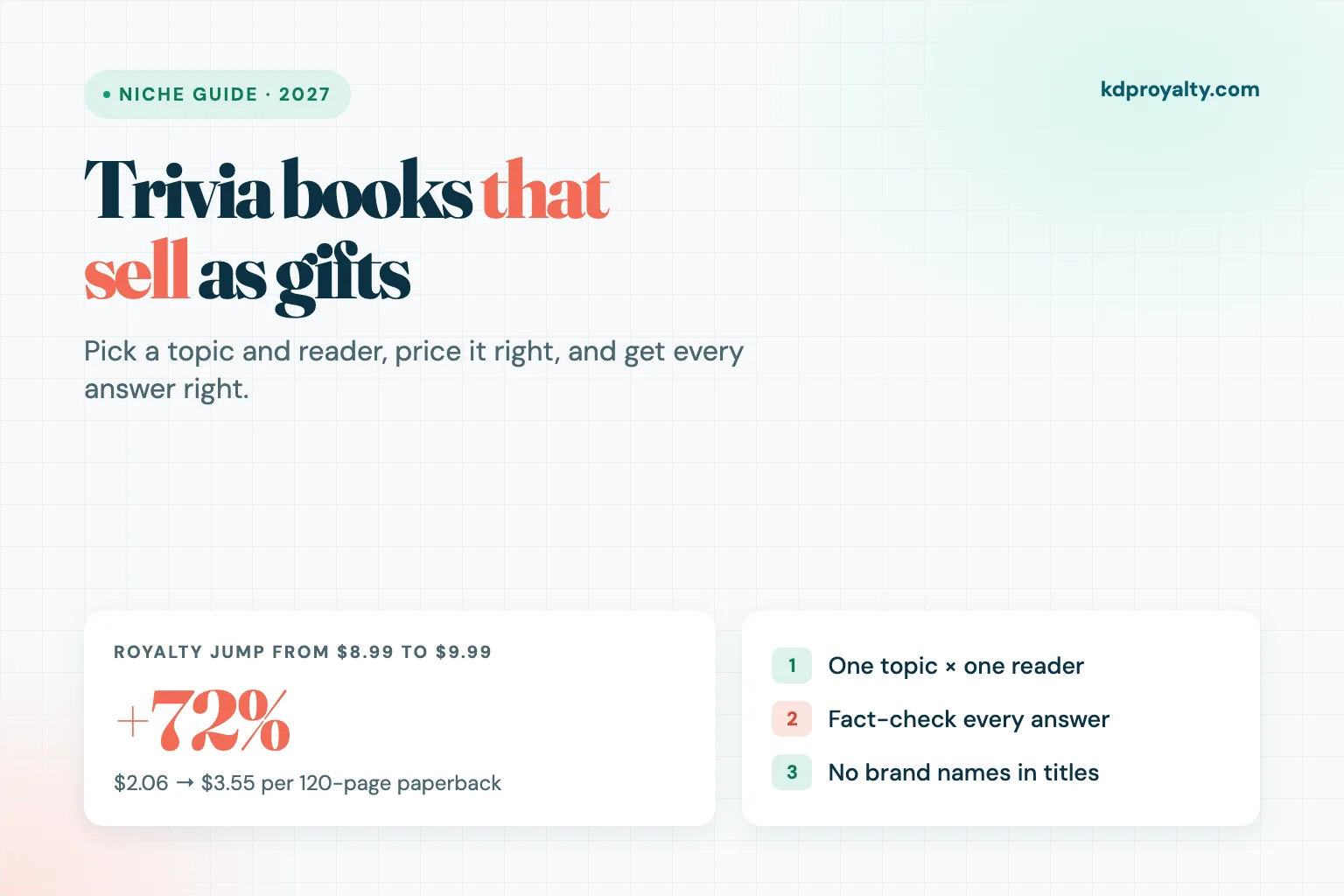
- Price a black-ink paperback at $9.99 or more. At $8.99 you earn about $2.06 a sale; at $9.99 about $3.55.
- Fact-check every question against reliable sources. One wrong answer can bring the one-star review that stalls the book.
- Stay away from brand and franchise names in the title.
- Publish 6–8 weeks before a gift season so the book has time to get reviews.
Why trivia books sell
- They're gifts. Birthdays, Christmas, Father's Day, graduations and "just because" presents for curious kids.
- They're evergreen. A book about volcanoes or ancient Egypt doesn't go out of date the way a tech guide does.
- They turn into series easily. One template can cover many topics and many readers.
- They're interactive. Families read them aloud, quiz each other, and pass them around on trips.
Buyers also judge them quickly. They look at the cover, the title and the reviews, then decide. A clear promise ("300 questions about the ocean for kids 8–12") beats a clever one.
Choose your book with the topic × reader grid
Most weak trivia books try to cover everything for everyone. Strong ones combine one topic with one reader.
Step 1: narrow the topic until a fan of it would say "that's exactly my thing":
Science → Nature → Animals → Ocean animals → Sharks
Step 2: pick the reader who'll enjoy it, or the person a buyer has in mind:
| Reader | What they want | Good formats |
|---|---|---|
| Kids 6–8 | Simple questions, big type, pictures | True/false, short facts |
| Kids 8–12 | "Did you know?" facts, a challenge | Multiple choice, quiz rounds with scores |
| Teens | Weird, surprising, funny | Fact plus question, "would you believe" |
| Adults | Deeper knowledge, nostalgia | Themed rounds, harder questions |
| Seniors | Memory, nostalgia, large print | Decades, music, films, everyday life |
| Families | Something to play together | Rounds, scorecards, answer key at the back |
Step 3: combine them. Some examples to show the idea (check demand before using any):
| Topic | Reader | Example angle |
|---|---|---|
| Sharks and ocean animals | Kids 8–12 | Ocean quiz book with a score chart for each chapter |
| Space and planets | Kids 6–8 | True-or-false space facts with simple pictures |
| US history | Adults | 500 questions from colonial times to the moon landing |
| 1960s and 1970s | Seniors | Large-print nostalgia trivia: music, TV, prices, fads |
| Weather and storms | Kids 8–12 | Tornadoes, hurricanes and lightning facts and quizzes |
| Road-trip geography | Families | State-by-state quiz rounds for the car |
| Dogs or cats | Pet lovers | Breed facts and behavior trivia, a gift for owners |
| Ancient civilizations | Teens | Egypt, Rome and Greece "weird but true" questions |
The same topic can become several books for different readers. Your second and third books are much faster because the template already exists. Remember KDP's limit of 2 new titles per format per week; quality matters more than speed anyway.
Check demand with BSR before you write
- Search Amazon Books for your topic plus "trivia", "quiz" or "facts" (for example "shark trivia for kids").
- Open the top 10–20 results and note each book's Best Sellers Rank, its publication date and whether it's self-published ("Independently published" in the details).
- Look for several books under about 50,000 BSR. If some of them are recent and self-published, it shows a newcomer can win there.
- Notice what's missing: a reader group nobody serves, a topic everyone treats too broadly, or weak covers on books that still sell.
Here's what a $12.99 paperback trivia book (120 pages, black ink, 6×9) earns at different ranks, using our calculator's BSR model:
| BSR | Sales per day | Royalties per day | Royalties per month |
|---|---|---|---|
| 5,000 | ~7 | ~$38 | ~$1,150 |
| 10,000 | ~4 | ~$22 | ~$670 |
| 20,000 | ~2.4 | ~$13 | ~$390 |
| 50,000 | ~1.2 | ~$6 | ~$190 |
| 90,000 | ~0.75 | ~$4 | ~$120 |
| 200,000 | ~0.4 | ~$2 | ~$65 |
Revenue isn't royalty. Research tools often show what customers paid per day. At $12.99 you keep about $5.35 of each sale, roughly 40%. Always convert a tool's "revenue" figure before you get excited.
Expect a strong seasonal swing: many gift books sell several times more in November and December than in spring. Check the BSR more than once, or look at a book's rank history if your research tool shows it.
Free tool
Try it: paste the top 10 ranks for your niche
Price and format: the numbers that matter
Trivia books are usually black-and-white paperbacks, 100–160 pages, 6×9. Here's what each sale earns on Amazon.com:
| Format | Pages | List price | Printing | Royalty per sale |
|---|---|---|---|---|
| Paperback, black ink, 6×9 | 120 | $8.99 | $2.44 | $2.06 |
| Paperback, black ink, 6×9 | 120 | $9.99 | $2.44 | $3.55 |
| Paperback, black ink, 6×9 | 120 | $12.99 | $2.44 | $5.35 |
| Paperback, standard color, 8.5×11 | 100 | $16.99 | $5.02 | $5.17 |
| Paperback, premium color, 8.5×11 | 100 | $19.99 | $9.00 | $2.99 |
| Hardcover, black ink, 6×9 | 120 | $22.99 | $7.09 | $6.70 |
Four lessons from the table:
- Don't price at $8.99. Below $9.99, KDP pays 50% instead of 60% on US paperbacks. Moving from $8.99 to $9.99 raises your royalty by about 72%.
- Black ink is the sweet spot. Simple line drawings work fine in black and white.
- Premium color rarely pays for a text-heavy book. If kids' pictures matter, standard color keeps a reasonable margin.
- Add a hardcover gift edition. Gift buyers are often happy to pay more for a hardcover. At $22.99 it earns more per sale than the $12.99 paperback, and it shows on the same product page.
Try your own page count and price here:
Free tool
Try it: find your minimum price and royalty
Design the inside so it's fun to use
How the questions are laid out makes a big difference to reviews:
- Put answers where they don't spoil the next question. Either at the end of each chapter or in an answer key at the back. Answers right under each question annoy anyone playing as a game.
- Mix question types: multiple choice, true or false, "fill in the blank" and "which one doesn't belong".
- Add a short fact after each answer. It teaches something and makes the book feel richer than a list of questions.
- Group questions into rounds of 10–25 with a score box. Families love keeping score.
- Raise the difficulty gradually and label it (easy, medium, hard).
- Use readable type. Large print matters for kids' and seniors' books.
- Use your own or licensed images only. Don't copy pictures from the web.
Fact-check everything (this is where most trivia books fail)
A trivia book is only as good as its answers. Readers who catch a mistake say so in reviews, and one or two "the answers are wrong" reviews can stop a book's sales.
AI can help you draft questions fast, but it also makes up facts confidently. Treat every AI-written fact as unverified:
- Check each answer against two reliable sources: encyclopedias, museums, universities, government agencies or the original records.
- Keep a simple source sheet (question, answer, source links) so you can fix anything a reader reports.
- Avoid answers that go out of date. For records like "the tallest building" or "the fastest car", add a date ("as of 2026").
- Watch for "fun facts" that are myths. Plenty of popular facts are wrong. Check them before you include them.
- Disclose AI use when you publish if AI generated the text or images, even if you edited them.
Avoid trademark problems
Trivia topics often involve brands, teams, films and celebrities. Their names are trademarks, and using them in a title can get your book blocked or removed, or bring a complaint from the owner.
- Don't put brand names in the title, subtitle or cover: famous magazine or record-book brands, sports leagues and team names, film and game franchises, toy brands, and so on.
- Describe the subject in plain words instead. For example, "pro football history trivia" instead of a league's name, or "wizard school trivia" instead of a book series title.
- Don't imply an official connection. Even with "unofficial" in the title, a book built around one franchise is risky.
- Search the US trademark database (USPTO) for any distinctive phrase you plan to use.
Generic subjects like oceans, space, history, animals and geography carry no such risk, which is another reason they're good first books.
Time it for gift seasons
Gift books follow the calendar. Plan backwards:
| Gift season | Buyers search from | Aim to publish by |
|---|---|---|
| Christmas | Early November | Mid-September to early October |
| Father's Day (June) | Mid-May | Early April |
| Mother's Day (May) | Mid-April | Early March |
| Graduation | May | Early April |
| Back to school / summer reading | June–August | April–May |
Publishing 6–8 weeks early gives you time to order a proof copy, fix mistakes, collect a few honest reviews, and start ads before costs rise in December. If you're reading this in late November, Christmas is too close for a brand-new book. Use the time to prepare for spring gift seasons and next Christmas.
Market it like a gift
- Write the description for the buyer: who it's for, the age range, the number of questions, and that answers are included.
- Add "gift" angles to your keywords, such as "gift for curious kids 8-12" or "road trip games for families", without stuffing the title.
- Run a small Amazon Ads campaign in the 6 weeks before each gift season. Know your break-even first: at $12.99 with a $5.35 royalty, your break-even ACOS is about 41%. See our ads break-even guide.
- Collect honest reviews early from readers who got a free copy and are free to leave any rating.
Checklist: your first trivia book
- Pick one topic and one reader using the grid.
- Check 10–20 competing books: BSR, age, self-published or not.
- Confirm several rank under ~50,000 with the BSR calculator.
- Plan 100–160 pages, black ink, 6×9, with an answer key.
- Draft questions (AI is fine), then fact-check each one with two sources.
- Keep brand and franchise names out of the title and cover.
- Price at $9.99 or more and add a hardcover gift edition.
- Get a bold cover that states the topic, the reader and the number of questions.
- Publish 6–8 weeks before a gift season, and disclose AI use honestly.
- Turn the template into a series for other topics or readers.
Royalties use KDP's US printing costs and royalty rates as of November 2026; sales are estimates from our BSR model and vary by season and category.
📈 Estimate your book royalties before publishing with our Amazon KDP royalty calculator.
Frequently asked questions
Do trivia books sell on Amazon KDP?
Yes, especially as gifts. Specific topics for specific readers, such as ocean trivia for kids 8–12 or nostalgia trivia for seniors, sell better than general fact books. Check that several books on your topic rank under about 50,000 BSR before you start.
How much does a trivia book earn on KDP?
A 120-page black-ink paperback at $12.99 earns about $5.35 per sale. At a BSR of 20,000 that's around 2–3 sales a day, or roughly $390 a month; at 90,000 it's under one sale a day, or about $120 a month.
What price should I set for a trivia book?
$9.99 or more for a black-ink paperback. Below $9.99 KDP pays 50% instead of 60% on US paperbacks, so a $8.99 book earns about $2.06 a sale versus $3.55 at $9.99. Many trivia books sell well at $10.99 to $12.99.
Can I use AI to write a trivia book?
Yes, but AI often invents facts, so check every answer against two reliable sources and keep a source list. Disclose AI-generated text or images when you publish on KDP.
Can I make a trivia book about a TV show, team or brand?
It's risky. Names of shows, franchises, sports leagues, teams and brands are usually trademarks, and using them in your title can get the book blocked or removed. Describe the subject in generic words instead, and search the trademark database for any phrase you use.
When should I publish a trivia book for Christmas?
Aim for mid-September to early October. That gives you time for a proof copy, a few honest reviews and some ads before buyers start searching in early November.
Topics
Ready to Run the Numbers?
Put this knowledge into action. Calculate your potential royalties before you publish.