10 Years of Amazon KDP: Every Era, What Ended It, and Why 2027 Is the Quality Era
From 5,000-word ebooks and review swaps to KENP tricks, CreateSpace, AI slop and the new two-books-a-week limit: a short history of how KDP changed, what each change ended, and how to build a publishing business that survives the next one.
Every year someone announces that KDP is dead. Every year some publishers quit after an Amazon change, and others adjust and keep growing.
In a recent video, It Took Me 10 Years on KDP to Realize What I'll Tell You in 21 Minutes (November 19, 2026), Emeka Ossai of Publishing Academy walks through the "eras" he's seen since 2016. His point: the publishers who last don't depend on any one trick. They react to changes calmly and keep their business focused on readers.
This guide summarizes those eras, adds dates and context where Amazon's history is clear, and turns the lesson into a practical plan for 2027.
The short version:
- KDP has moved from a quantity game (many thin books, bought reviews, page-read tricks) to a quality game.
- Almost every "era" ended because Amazon closed something that was bad for customers.
- The current rules point the same way: 2 new titles per format per week, AI disclosure on every upload, and stricter review rules.
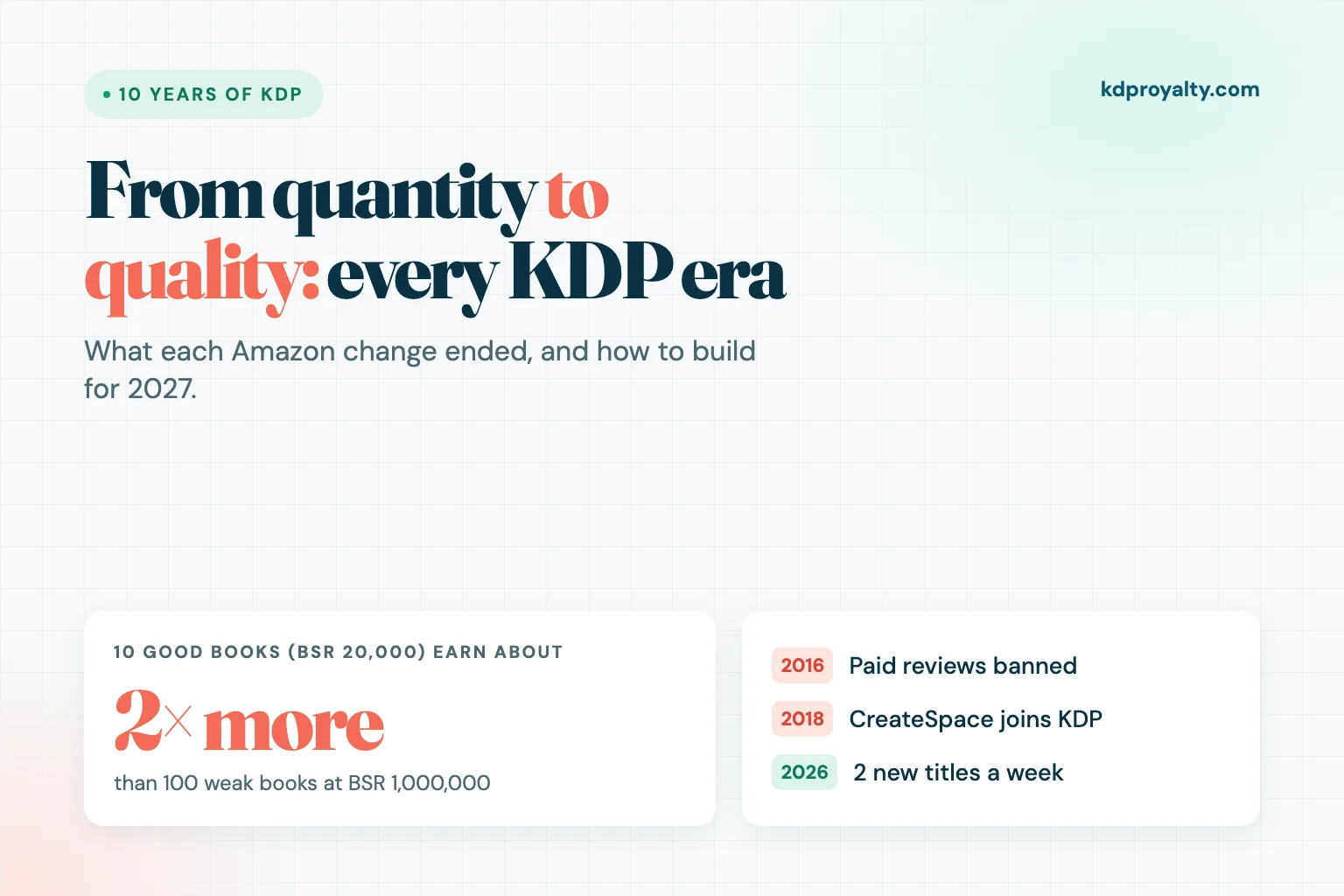
- The math favors fewer, better books. Ten books selling at a BSR of 20,000 earn more than 100 books at a BSR of 1,000,000.
The quantity eras (roughly 2014–2023)
1. The short-ebook era
When the video's author started in 2016, many publishers sold only ebooks: around 5,000 words, ghostwritten cheaply, with a basic cover. With little competition, almost any book on a searched topic sold a few copies. More books meant more money.
What ended it: competition and readers. Short, thin books started getting refunds and one-star reviews, and better books took their place in search.
2. The review-swap era
Publishers paid people, often around a dollar a review, to post reviews, or swapped reviews with other authors.
What ended it: Amazon. It banned incentivized reviews in 2016 and has removed fake reviews and closed accounts over them ever since. Today, paying for reviews, swapping reviews, or getting reviews from family and close friends all break Amazon's rules.
3. The KENP-manipulation era
Kindle Unlimited began paying authors per page read (KENP) in 2015. Some publishers padded ebooks so that readers' devices registered thousands of pages, for example by putting the real content at the very end of a stuffed file.
What ended it: Amazon changed how it counts pages, removed padded books and closed accounts. Kindle Unlimited (now Kindle+) still pays per page, but only for real reading. See how Kindle+ pays authors.
4. The proper-book era
As thin ebooks stopped working, serious publishers moved to 20,000–30,000-word non-fiction books written by ghostwriters, focused on helping the reader. The video calls this the era that "put self-publishing on the map" as a business.
5. The CreateSpace era
Paperbacks used to be sold through CreateSpace, a separate Amazon company. Authors remember it fondly for its support team and fast payments. The video also recalls a pricing quirk of that time that let some publishers earn far more per paperback than they do today.
What ended it: Amazon merged CreateSpace into KDP Print in 2018. Paperbacks now use KDP's standard formula: 60% of the list price (50% under $9.99 in the US) minus printing. Our paperback royalty calculator uses those rules.
6. The audiobook review-code era
On ACX, authors could hand out free promo codes for audiobook reviews. The video recalls a period when those codes earned authors money as well as reviews, which pushed rankings up.
What ended it: Audible changed how promo codes work. They're still useful for getting honest reviews, but not as an income source. For today's audiobook rates, see our ACX royalty guide.
7. The AI-slop era
When AI writing tools arrived, some publishers uploaded books made with little more than one prompt.
What ended it: three things at once.
- Amazon: it required AI disclosure from September 2023 and limited how many titles an account could create.
- Readers: they left bad reviews.
- Better tools: AI got good enough that low-effort books stood out as worse.
8. The free-promotion review era
Authors in KDP Select used free promotion days to give away many copies and collect reviews.
What changed: the video says Amazon tightened up on this around late 2025, and that using free days mainly to collect reviews now risks your account. Free days still exist in KDP Select. Just don't treat them as a review machine, and never offer anything in exchange for a review.
9. The publish-as-much-as-you-can era
Some accounts held hundreds or even thousands of titles.
What ended it: from September 21, 2026, KDP lets an account create up to 2 new titles per format per week, and from October 5 it also caps submissions at the same level. Ebook, paperback and hardcover count separately, and edits to existing books don't count. The details are in our 2027 KDP guide.
As the video puts it, if you were publishing more than two books a week, they almost certainly weren't good books.
The quality era (now)
Almost every change above pushed KDP in one direction: fewer, better books that readers actually want. The video argues this is good news. More publishers now earn large incomes without loopholes than in the "wild west" days.
Why the numbers favor quality
Using our calculator's BSR model for a $14.99 paperback (120 pages) plus a $4.99 ebook in the US store:
| Each book's BSR (both formats) | Royalties per book / month | 10 books | 100 books |
|---|---|---|---|
| 10,000 | ~$1,310 | ~$13,100 | — |
| 20,000 | ~$760 | ~$7,580 | — |
| 300,000 | ~$90 | ~$900 | ~$9,000 |
| 1,000,000 | ~$35 | ~$350 | ~$3,500 |
Ten good books at a BSR of 20,000 earn about twice as much as 100 weak books at 1,000,000. The ten books also take far less time and far fewer uploads, and they carry no risk of losing your account. Under the new limit, 100 titles would also take months.
Run your own numbers with the KDP royalty calculator or turn any rank into sales with the BSR calculator.
Free tool
Try it: convert any BSR into sales and royalties
Amazon Sales & Royalty Calculator
KDP royalty rates and printing costs, July 2026
Product details on Amazon
$0.15/MB fee at 70%. Blank = 1 MB
AI is a tool, not the product
The video is firmly pro-AI. Writers no longer need a $1,500 ghostwriter or perfect English to publish. But because everyone has AI, AI itself isn't an advantage, and neither are the old basic selling points.
Its example is seniors' books: "large print" used to set a book apart. Now nearly every senior-focused book is large print, so it says no more than "this book has words in it". A real unique selling point today is a specific reader, problem or format that competing books don't serve. Our niche guide for 2027 has examples.
What to expect next
The video predicts that Amazon will eventually show AI labels on product pages for customers. That isn't announced. Today, KDP collects AI disclosure only for itself. But it's worth planning for. A book you'd be comfortable labeling "made with AI" because it's genuinely good is safe either way.
How to handle the next KDP change
The video's main lesson isn't about any one rule. It's about how you react. When Amazon changes something:
- Don't panic with the crowd. Every change brings a wave of "KDP is dead" videos and posts. They get clicks, but they don't tell you what to do.
- Read the official source. Check KDP's help pages or the announcement email before acting on rumors.
- Ask what it changes for your business. Usually it's one or two things, such as your upload schedule, how you collect reviews, or a price.
- Watch the experienced publishers. Most of them adjust quietly and keep going.
- Build so that changes don't hurt. Write real books for real readers, follow the review rules, disclose AI, and spread your income across several books, formats and marketplaces.
Amazon makes changes to help its customers buy. If customers find good books more easily, publishers of good books sell more.
Checklist for the quality era
- Publish fewer books, and make each one the best answer for a specific reader.
- Pick a topic with demand: check the top 10 BSRs in the niche checker.
- Use AI to research, outline and draft, then edit and fact-check it yourself. Disclose AI content when you publish.
- Get reviews honestly: ARC readers get a free copy and are free to leave any rating. Never pay or swap.
- Stay well inside the 2-titles-per-format-per-week limit.
- Price for profit with the royalty calculator, and know your ads break-even point.
- When KDP changes, read the official note first, then adjust one thing at a time.
This guide summarizes a public video by Emeka Ossai (Publishing Academy); we're not affiliated. Dates come from Amazon's public announcements and our earlier coverage. Earnings are estimates from our BSR model, not guarantees.
📊 Before you publish, run the numbers with our free KDP royalty calculator.
Frequently asked questions
Is Amazon KDP dead in 2027?
No. KDP has changed many times, and each change ended a shortcut, not the business. Publishers who write good books for specific readers keep earning; strategies based on volume, bought reviews or page-read tricks have stopped working.
How many books can I publish on KDP per week?
Since September 21, 2026, each account can create up to 2 new titles per format per week, and since October 5, 2026, submit up to 2 new titles per format per week. Ebook, paperback and hardcover count separately, and edits to existing books don't count.
What happened to CreateSpace?
Amazon merged CreateSpace into KDP in 2018. Paperbacks are now published through KDP Print and earn 60% of the list price (50% under $9.99 in the US) minus printing costs.
Are review swaps allowed on Amazon?
No. Amazon doesn't allow review swaps, paid reviews, or reviews from family and close friends. Giving free advance copies is fine as long as readers are free to leave any rating and nothing is offered in exchange.
Will Amazon label AI-generated books?
Not currently. KDP asks you to disclose AI-generated text, images and translations when you publish, but readers don't see it. Some publishers expect public labels in the future, so it's safest to publish AI-assisted books you'd be happy to have labeled.
Is it better to publish many books or a few good ones?
A few good ones. Using typical prices, 10 books selling at a BSR of 20,000 earn about $7,500 a month, roughly twice as much as 100 books at a BSR of 1,000,000, with far less work and risk.
Topics
Ready to Run the Numbers?
Put this knowledge into action. Calculate your potential royalties before you publish.