How to Make $10K a Month on Amazon KDP in 2026: The 5-Step Plan, Checked With Real Numbers
A popular 2026 video lays out a 5-step plan for a $10,000-a-month KDP business: topic, research, AI writing, cover, launch. Here's each step, what it leaves out, and the royalty math for how many books and sales $10K really takes.
"$10K a month on Amazon KDP" is one of the most common promises in self-publishing videos. A recent one, How to Make $10K/Month on Amazon KDP in 2026 by Roberto of Accelerated Publishing (published November 22, 2026), is one of the clearer versions. It lays out a five-step plan for non-fiction books written with AI help.
The plan is sensible. What the video doesn't do is show the math: how many books, how many sales a day and what Best Sellers Rank it takes to actually reach $10,000. That's what this guide adds, using the same formulas as our KDP royalty calculator.
The short version:
- The five steps are: find a topic with demand, research what readers really want, write with AI one chapter at a time, get a strong cover, and launch with a few reviews and simple ads.
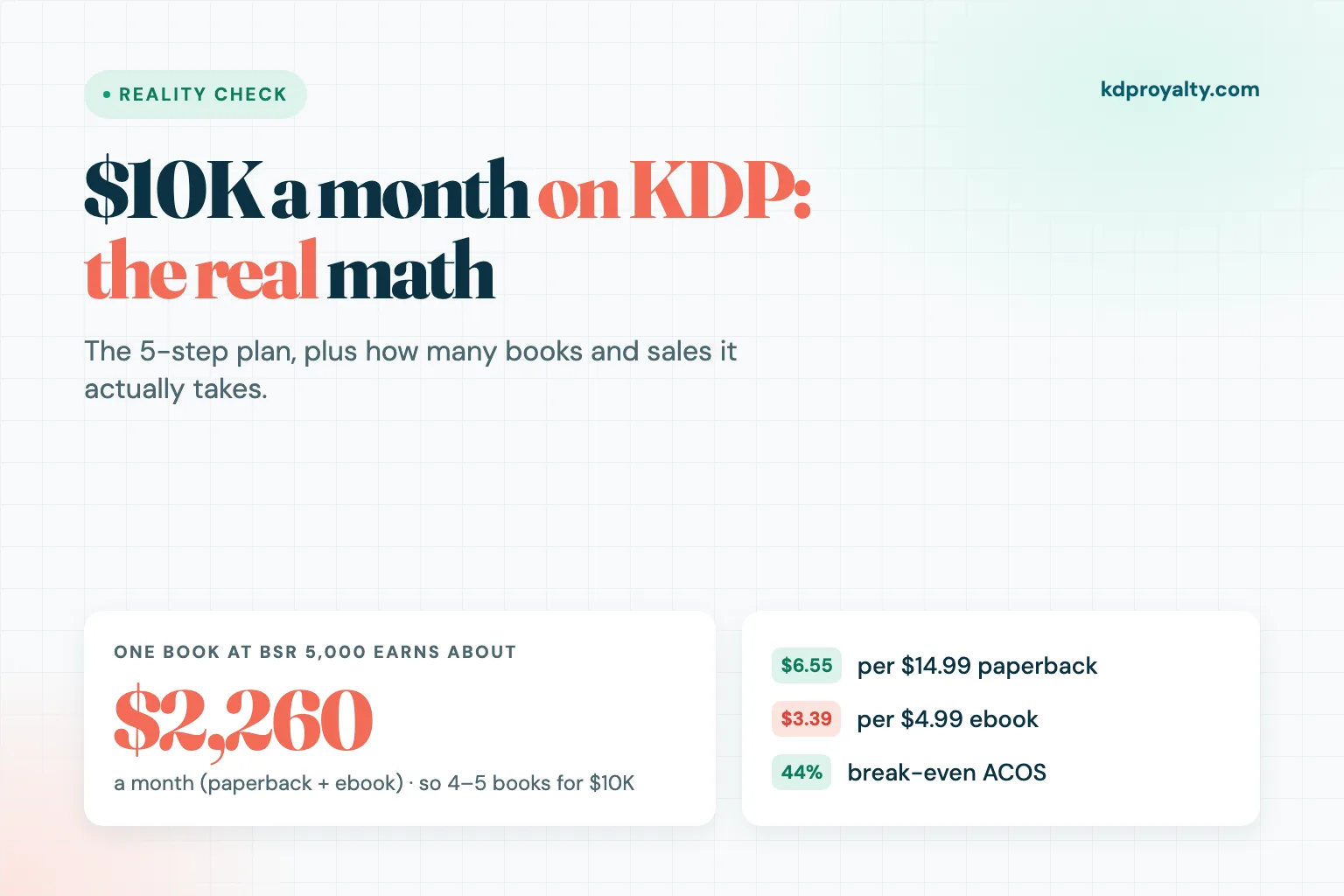
- $10K a month is royalties, not sales. A non-fiction paperback at $14.99 earns about $6.55 per sale; a $4.99 ebook earns about $3.39.
- One book selling in both formats at a BSR around 5,000 earns roughly $2,260 a month. So $10K takes about four or five books that strong, or a dozen or more weaker ones.
- Most authors get there with a catalog built over a year or more, not with one book.
Step 1: Find a topic people are already buying
The video's core idea is right: don't try to create demand. Find a topic people already buy, where the existing books are few or weak, and publish a better one.
Its two free sources are both on Amazon:
- Best Sellers → Books → a category (for example Health, Fitness & Dieting → Exercise & Fitness). Look for words and themes that repeat across titles.
- New Releases in the same category. A recent book that's already selling well proves the demand is current, not left over from years ago.
The example in the video is calisthenics workouts for men over 50, which showed up in both lists.
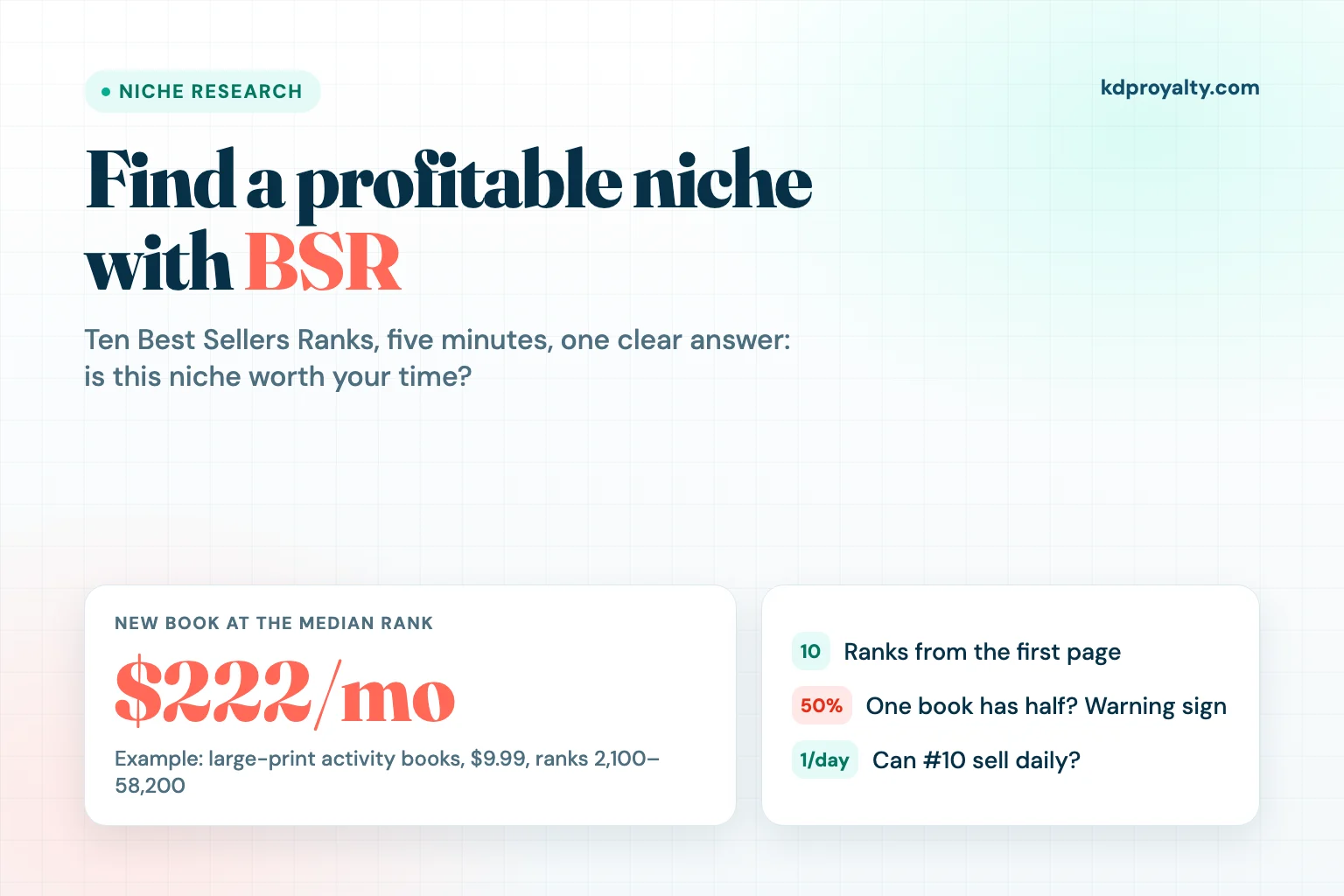
What to add: check the numbers before you commit. Paste the BSRs of the top 10 books for your keyword into our niche checker, or turn a single BSR into sales with the BSR calculator. Our guide to finding a profitable niche using BSR explains the thresholds.
Watch out for "revenue" numbers. Research tools often show monthly revenue, which is what customers paid, not what you keep. A paperback "making $6,000 a month" at $14.99 is about 400 sales. At a typical royalty of $6.55, that's roughly $2,600 to the author. It's still a good book, but less than half the headline.
Step 2: Research what readers really want
The video calls this the "intelligence phase", and it's the most useful part. It has three pieces:
- Learn the topic well enough. You don't need to be an expert, just better informed than the average reader, and accurate.
- Find the real reason people buy. Read 1–3 star reviews of competing books and look for complaints, failed attempts and hopes. Then ask "why?" two or three times. A woman in her 60s wants to lose weight → to stay independent → so she doesn't miss time with her family as she gets older. That deeper reason shapes a much stronger book and description.
- Choose an angle. Instead of competing in "weight loss for women", either narrow the topic (home bodyweight workouts for women) or narrow the reader (weight loss for women over 65).
This is how new books still win in "saturated" niches: they're the best answer for a smaller, specific group.
Step 3: Write with AI, one chapter at a time
The video recommends using a general AI assistant directly (around $20 a month) rather than paying for "AI book writer" tools that run on the same models. Its process:
- Have the AI build a detailed outline from your research first.
- Aim for 15,000–25,000 words, a common length for practical non-fiction.
- Write one chapter at a time, with prompts that set the reader, tone and goal, then edit.
What to add:
- Disclose AI content. When you publish, KDP asks whether your text, images or translations are AI-generated. You must answer honestly. Amazon doesn't show this to readers, but not disclosing it can break KDP's content rules.
- Check every fact yourself, especially in health, money or legal topics. Reviews punish errors fast.
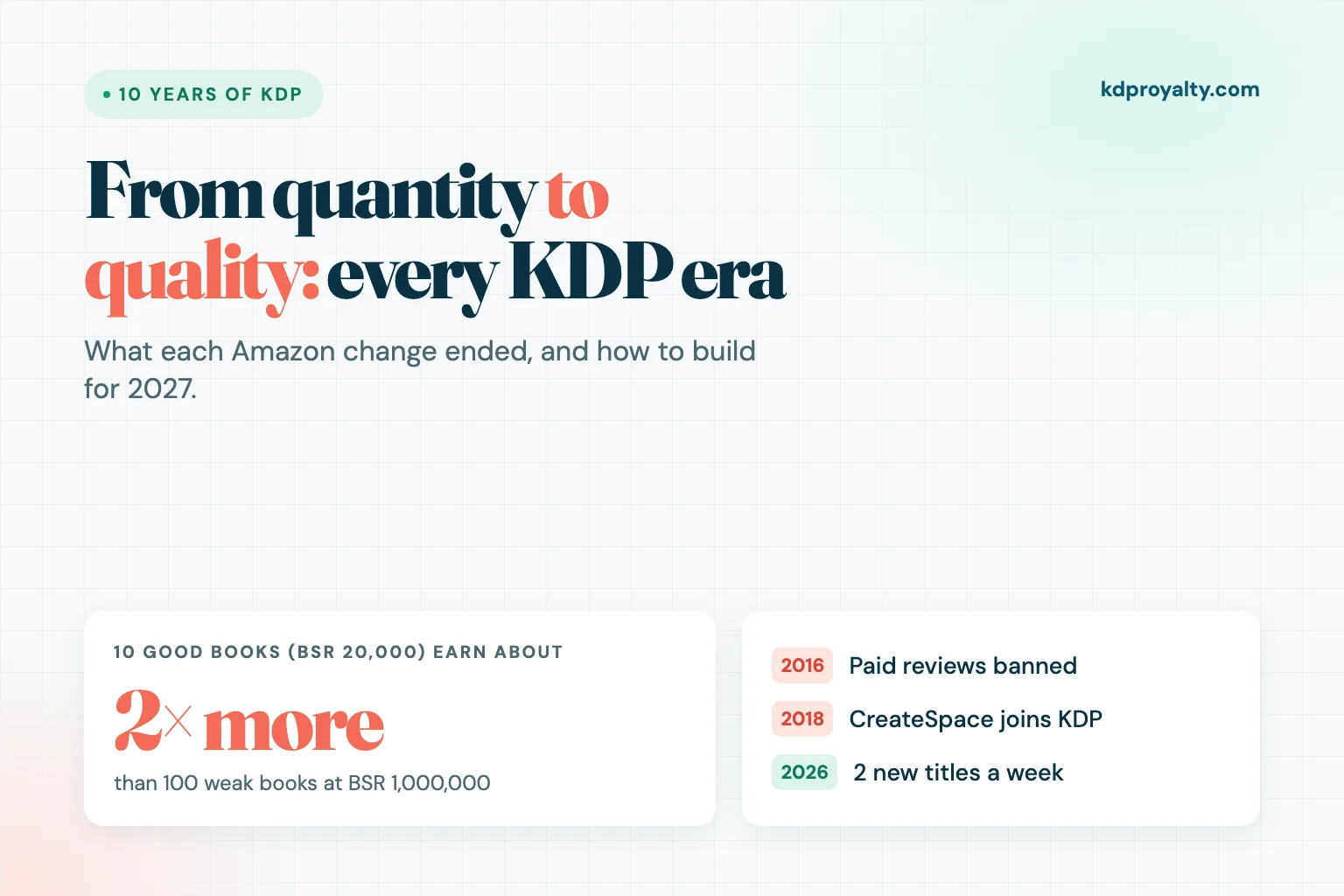
- KDP limits new titles to 2 per format per week, and it removes low-effort, duplicate or misleading books. Speed matters less than quality. A thin book gets refunds and bad reviews, and that ends its sales.
Step 4: Get a cover that sells in a thumbnail
Shoppers on Amazon decide in a second, from a small image. The video compares a strong and a weak cover. The strong one has:
- a title you can read at thumbnail size, with high contrast against the background
- an image that matches the promise (a uniformed man for military-style training)
- a few short benefits ("20 minutes a day", "no equipment")
The weak one has a subtitle bigger than the title and a title the same color as the background.
You can design a cover with AI image tools, in Canva, or with a freelancer. Get the exact size right first: our cover size calculator gives the full-wrap dimensions and spine width for your page count.
Step 5: Launch with reviews and simple ads
The video says a launch needs two things: a few early reviews and a few early sales.
Reviews. It suggests aiming for 7–10 genuine reviews. Be careful here: Amazon doesn't allow paying for reviews, swapping reviews, or reviews from family and close friends. Advance-reader (ARC) services can work only if readers get a free copy and are free to leave any rating. Read the service's terms against Amazon's Community Guidelines before you use one.
Ads. The beginner setup in the video is simple, and it's a good start:
- One automatic campaign, with a $5 daily budget. Amazon chooses where to show the book. New campaigns often spend only $1–2 a day at first.
- One keyword campaign with your main title keyword on broad match, so Amazon also shows the book for close variations (for example "weight loss over 65" or "losing weight for older women").
What to add: know your break-even before you spend. You only lose money on ads when the ad cost per sale is more than your royalty:
| Format | List price | Royalty per sale | Break-even ACOS |
|---|---|---|---|
| Paperback, 120 pages, 6×9 | $14.99 | $6.55 | about 44% |
| Ebook, 70% royalty | $4.99 | $3.39 | about 68% |
At a $5 daily budget you can spend up to about $150 a month per campaign, so check your ACOS weekly. Our ads break-even guide explains how.
Free tool
Try it: find your break-even ACoS and maximum bid
The math: what $10K a month actually takes
Here's a non-fiction book in the US store, sold as a $14.99 paperback (120 pages, black ink, 6×9) and a $4.99 ebook. Sales come from our calculator's BSR model and are estimates. Real books vary a lot.
| BSR (both formats) | Paperback sales / month | Ebook sales / month | Royalties / month |
|---|---|---|---|
| 2,000 | ~440 | ~520 | ~$4,645 |
| 5,000 | ~215 | ~250 | ~$2,255 |
| 10,000 | ~125 | ~145 | ~$1,310 |
| 20,000 | ~73 | ~83 | ~$760 |
| 50,000 | ~36 | ~40 | ~$370 |
So to reach $10,000 a month in royalties (before ad costs), you'd need roughly:
- 2–3 books holding a BSR around 2,000, or
- 4–5 books around 5,000, or
- 8 books around 10,000, or
- 13+ books around 20,000.
Most catalogs are a mix: one or two strong books and several modest ones. Kindle Unlimited (now Kindle+) page reads can add to this; see our Kindle+ guide and the Kindle Unlimited calculator.
Also remember:
- Ad spend comes out of this. If you spend $1,500 a month on ads, you need $11,500 in royalties to keep $10,000.
- Ranks move. Most books sell well for months, not forever. A catalog smooths that out.
- Taxes are separate. Royalties are business income in most countries.
Free tool
Try it: convert any BSR into sales and royalties
Amazon Sales & Royalty Calculator
KDP royalty rates and printing costs, July 2026
Product details on Amazon
$0.15/MB fee at 70%. Blank = 1 MB
Is $10K a month realistic?
For a small number of publishers, yes. KDP pays out millions a month, and some practical non-fiction books do sell hundreds of copies a month for years. But it's the result of several good books, each built with steps 1–5, not one lucky upload.
A realistic path looks like this:
- First book: aim for $100–500 a month. Treat it as practice on the whole process.
- Books 2–5: use what sold. Publish in the same niche or for the same reader.
- After that: put ad money behind the books that already convert, and drop the ones that don't.
Our guides on how many books it takes to make $1,000 and how long it takes to make money on KDP go deeper on the early stage.
Checklist
- Pick a topic that shows up in both Best Sellers and New Releases.
- Check the top 10 BSRs with the niche checker.
- Read competitor reviews and choose a narrower topic or reader.
- Outline, then write 15,000–25,000 words one chapter at a time, and fact-check it.
- Disclose AI content when you publish.
- Get a high-contrast cover sized with the cover calculator.
- Price it with the royalty calculator and know your break-even ACOS.
- Launch with honest ARC reviews, one auto campaign and one broad keyword campaign at $5 a day.
- Repeat with what worked.
This guide summarizes and fact-checks a public video by Accelerated Publishing; we're not affiliated with them. Royalty math uses KDP's published US royalty rates and printing costs; sales are estimates from our BSR model.
📊 Before you publish, run the numbers with our free KDP royalty calculator.
Frequently asked questions
Can you really make $10K a month on Amazon KDP?
Some publishers do, but it usually takes several good books, not one. For a $14.99 paperback and $4.99 ebook, a book selling at a BSR around 5,000 in both formats earns roughly $2,260 a month, so $10,000 takes about four or five books that strong, before ad costs.
How many sales a day do you need for $10,000 a month?
At about $6.55 per paperback and $3.39 per ebook, $10,000 a month is roughly 2,000 sales a month in total, or around 65–70 sales a day across all your books.
Is it allowed to write KDP books with AI?
Yes, but KDP requires you to disclose AI-generated text, images or translations when you publish. You're still responsible for accuracy and quality, and KDP removes low-quality or misleading books.
How long should a non-fiction KDP book be?
Many practical non-fiction books are 15,000 to 25,000 words. That's roughly 80 to 130 pages in a 6×9 paperback, depending on formatting.
What's a good starting ad budget for a new KDP book?
A common beginner setup is one automatic campaign and one broad-match keyword campaign at $5 a day each. New campaigns often spend less than that at first. Check your ACOS against your break-even: about 44% for a $14.99 paperback with a $6.55 royalty.
Can I pay for Amazon book reviews?
No. Amazon doesn't allow paid reviews, review swaps, or reviews from family and close friends. Advance-reader services are only acceptable if readers receive a free copy and are free to leave any rating.
Topics
Ready to Run the Numbers?
Put this knowledge into action. Calculate your potential royalties before you publish.