How to Find a Profitable KDP Niche Using BSR (Step-by-Step, Free Checker)
A practical, 15-minute method for checking whether a KDP niche is worth your time: collect the top 10 Best Sellers Ranks, turn them into sales and royalties, and read the warning signs, with two worked examples.
Most KDP books don't fail because they're bad. They fail because nobody was searching for them in the first place. Picking the niche is the decision that matters most, and it's the one most authors make on gut feeling.
You don't need a paid research tool to do it properly. Amazon shows you the most useful number for free on every book page: the Best Sellers Rank (BSR). This guide shows you how to turn the BSRs of the top books in a niche into a clear answer: is there enough demand, is it spread out enough for a newcomer, and what could your book earn?
Why BSR Is the Best Free Niche Signal
BSR ranks every book in a store by recent sales. A rank of 1 is the best seller; a rank of 2,000,000 sells almost nothing. Because it's based on actual sales, it cuts through guesswork about what "should" sell.
Here's roughly what a rank means in copies sold on Amazon.com, from the same model our calculators use:
| BSR | Ebook sales a month | Paperback sales a month |
|---|---|---|
| 1,000 | ~908 | ~754 |
| 5,000 | ~250 | ~215 |
| 10,000 | ~144 | ~125 |
| 30,000 | ~60 | ~53 |
| 50,000 | ~40 | ~36 |
| 100,000 | ~23 | ~21 |
| 300,000 | ~9 | ~9 |
One book's rank tells you about one book. Ten books' ranks tell you about the niche. That's the whole method.
Step 1: Search the Way a Buyer Would
Go to Amazon (logged out, or in a private window) and type the phrase a real buyer would use, not your book's title:
- ✅ "large print word search for seniors"
- ✅ "cozy mystery with cats"
- ✅ "gratitude journal for teens"
- ❌ "puzzle book" (too broad)
- ❌ "my amazing journal" (nobody searches for that)
The more specific the phrase, the more useful the answer. Broad terms mix many niches together.
Step 2: Collect the Top 10 Best Sellers Ranks
Open each of the first 10 results, skipping sponsored listings. Scroll to Product details and copy the main rank: the one that says "in Kindle Store" or "in Books". Ignore the smaller category ranks underneath; they're inflated by tiny categories.
Write down all ten. It takes about five minutes.
Tip: ranks change every hour. For a decision you'll invest weeks in, collect them on two or three different days.
Step 3: Turn the Ranks Into Sales and Royalties
Paste the ten ranks into our free KDP niche checker, set the format and a typical price, and it does the math: each book's estimated monthly sales and royalties, the niche total, and what a new book could earn.
Free tool
Try it: paste the top 10 ranks for your niche
Step 4: Read the Four Signals
Don't just look at the total. These four numbers tell you far more:
- The median rank (middle book). This is your realistic target. If a good book in this niche typically ranks here, what does that earn?
- The weakest book in the top 10. This is the entry bar. If even #10 sells a copy a day, there's room below the leaders.
- How many books sell at least one copy a day. Sales spread across many titles mean readers buy more than one book, which is good for newcomers.
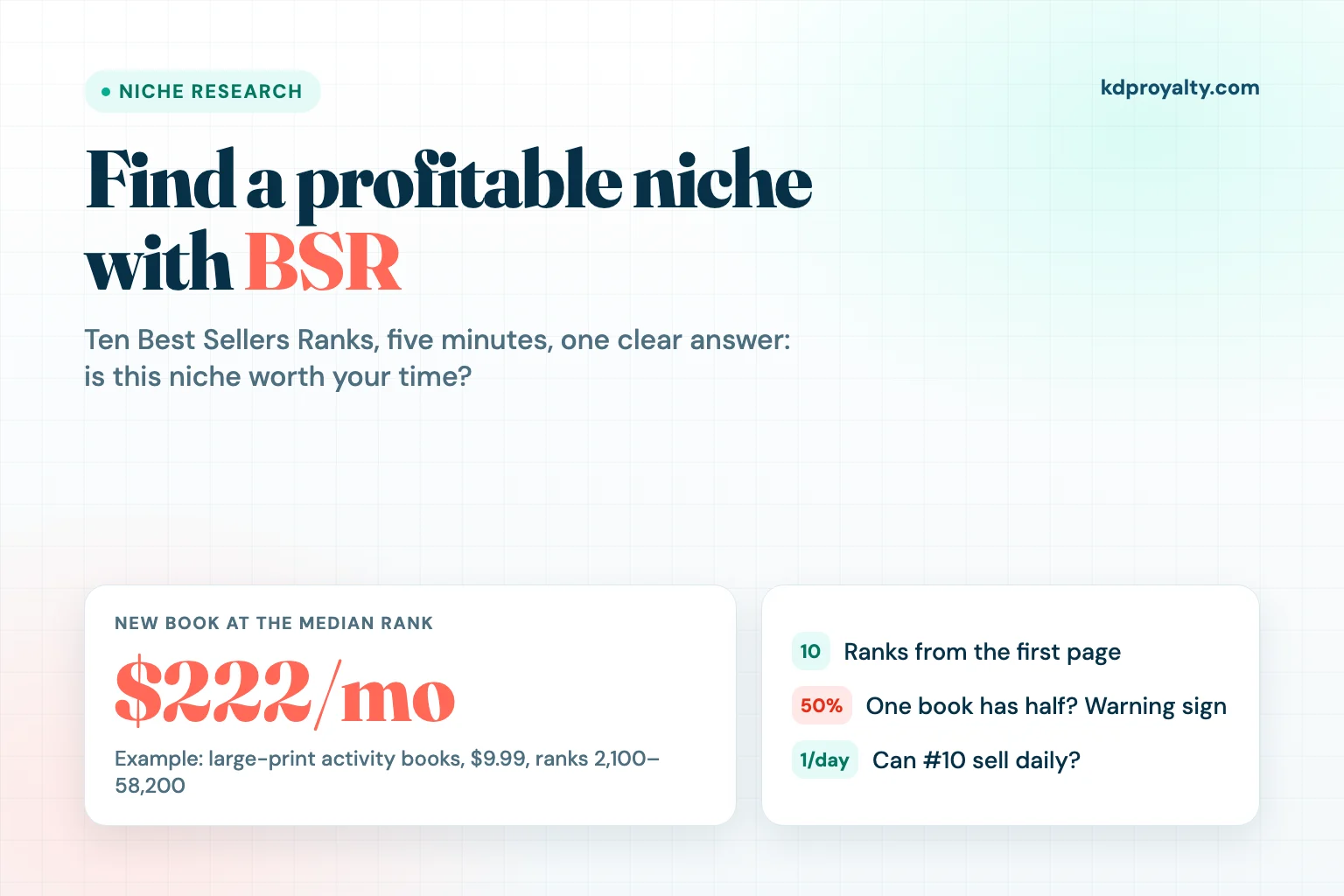
- The top book's share of sales. If one book takes half or more, buyers are loyal to it. A similar book will struggle.
Worked Example 1: A Healthy Niche
Ten large-print activity books (8.5×11, 120 pages, priced at $9.99) with ranks from 2,100 to 58,200:
- Median rank: ~19,250, about 75 sales a month
- Weakest book (#10): about 32 sales a month, so even the bottom of the list sells daily
- Books selling 1+ copy a day: 10 of 10
- Top book's share: 34%
- Royalty per copy: $2.95 (60% × $9.99 − $3.04 printing)
- A new book at the median rank: ~$222 a month
Verdict: strong demand with room for more. A well-made book with a better cover than the weakest titles has a real chance here.
Worked Example 2: A Trap That Looks Good
Same format and price, but the ranks are 350, then 61,000 to 450,000:
- The niche's total sales look impressive (over 1,800 a month)
- But the #1 book takes 93% of them
- Median rank: ~170,000, about 14 sales a month
- Only 2 of 10 books sell a copy a day
- A new book at the median rank: ~$41 a month
Verdict: dominated by one book. The demand is real, but it belongs to the leader. Unless you have a clearly different angle, this niche will disappoint, even though its total looks bigger than Example 1's.
That's why you never judge a niche by its best seller or its total alone.
Step 5: Check What the Numbers Can't Tell You
Sales data shows demand. Before you commit, spend ten more minutes on:
- 2- and 3-star reviews of the top books. Repeated complaints ("print too small", "answers missing", "pages bleed through") are your opportunity.
- Covers and titles. If the top books look dated or generic, a professional cover can win.
- Who's selling. A top 10 full of big publishers is harder than one with self-published titles.
- Royalty per copy. A busy niche at a low price can leave you very little after printing. Check yours with the paperback royalty calculator.
Rules of Thumb
| What you see | What it means |
|---|---|
| Most of the top 10 under BSR 30,000 | Strong demand |
| The #10 book sells 1+ a day | Room for newcomers |
| One book has 50%+ of sales | Loyal readers; needs a different angle |
| Most books above BSR 300,000 | Very few buyers |
| Many self-published titles in the top 10 | Achievable for independent authors |
Common Mistakes
- Using category ranks instead of the main store rank.
- Checking only once. A single snapshot can catch a book during a promotion.
- Judging by the best seller. One huge title can hide a dead niche behind it.
- Ignoring the price. Demand at $6.99 for a large paperback may not leave room for a royalty.
- Skipping the reviews. The numbers show demand; the reviews show how to win it.
Next Steps
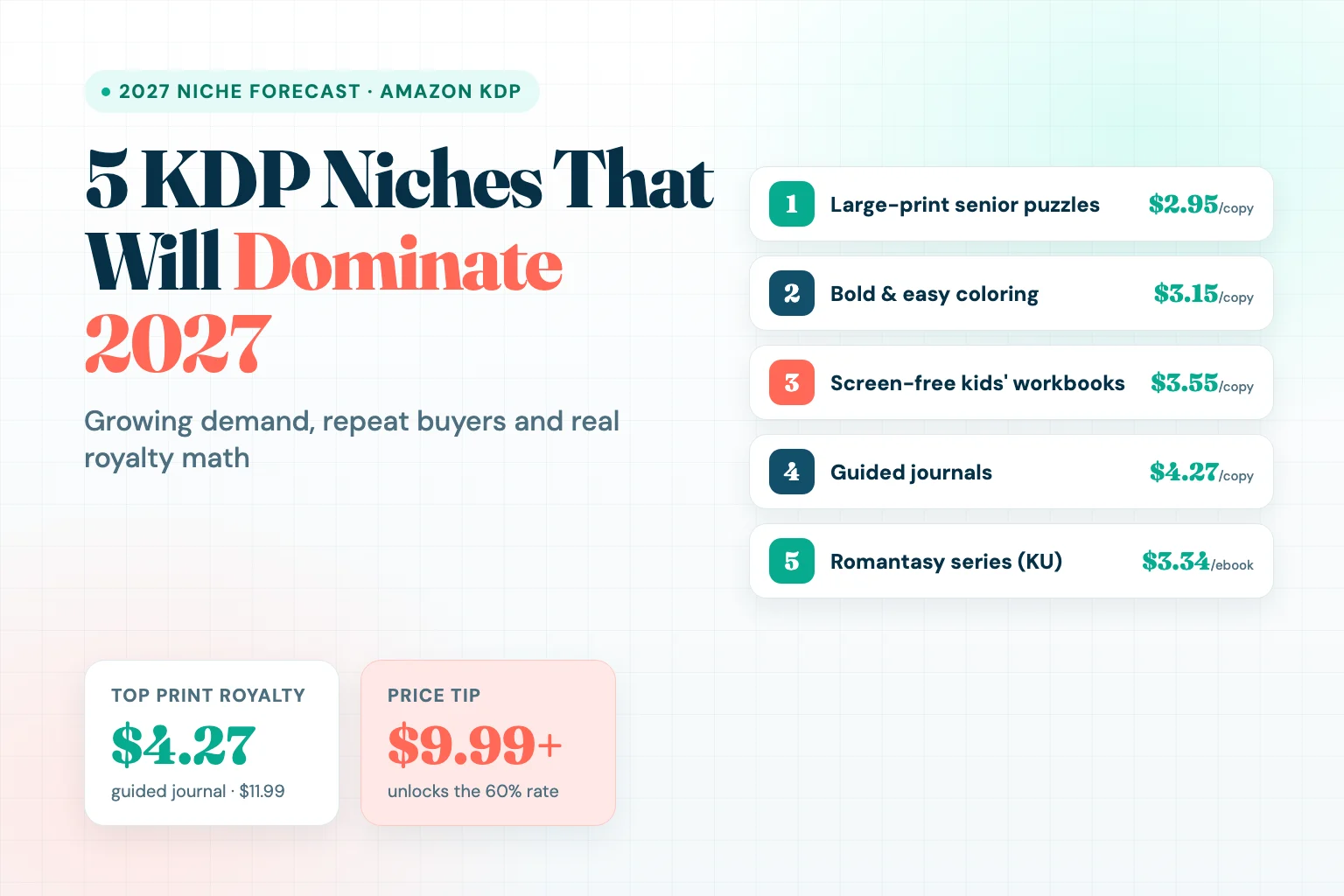
Found a promising niche? Plan a series rather than a single book, check your printing costs and minimum price, and price at or above KDP's 60% royalty threshold. For ideas worth checking, start with our five KDP niches for 2027 and our coloring book niche guides, then run each one through the niche checker.
📊 Before you publish, run the numbers with our free KDP royalty calculator.
Frequently asked questions
How do I know if a KDP niche is profitable?
Collect the Best Sellers Ranks of the top 10 books for a buyer's search phrase and turn them into sales. A profitable niche has a median book selling a few copies a day, even its 10th book selling about one a day, and sales spread across several titles rather than one bestseller.
What BSR is good for a KDP niche?
On Amazon.com, an ebook around BSR 30,000 sells about 60 copies a month and a paperback about 53. If most of the top 10 books rank under 30,000, demand is strong. If most rank above 300,000, there are very few buyers.
Which rank should I use, the main rank or the category rank?
The main store rank, shown as 'in Kindle Store' or 'in Books' in Product details. Category ranks are much smaller numbers because they compare a book only with others in a narrow category, so they make niches look bigger than they are.
How many books should I check in a niche?
The first 10 organic results for your search phrase, skipping sponsored listings. That's the first page buyers see, and it's enough to see both the demand and how evenly it's shared.
Is a niche with one huge bestseller a good sign?
Usually not. If one book takes half or more of the niche's sales, readers are loyal to it and a similar book will struggle. In our example, a niche with a #1 book at rank 350 gave a new book only about $41 a month at the median rank.
Do I need a paid tool for KDP niche research?
No. Best Sellers Ranks are free on every Amazon book page. A free tool like our KDP niche checker turns them into sales, royalties and a verdict. Paid tools add keyword volumes and history, which are helpful but not required to start.
Topics
Ready to Run the Numbers?
Put this knowledge into action. Calculate your potential royalties before you publish.