
Is Amazon KDP Still Worth It in 2026? (Honest Analysis)
An honest, no-hype analysis of whether Amazon KDP is still a viable path for self-publishers in 2026. What's changed, what still works, and who should start.
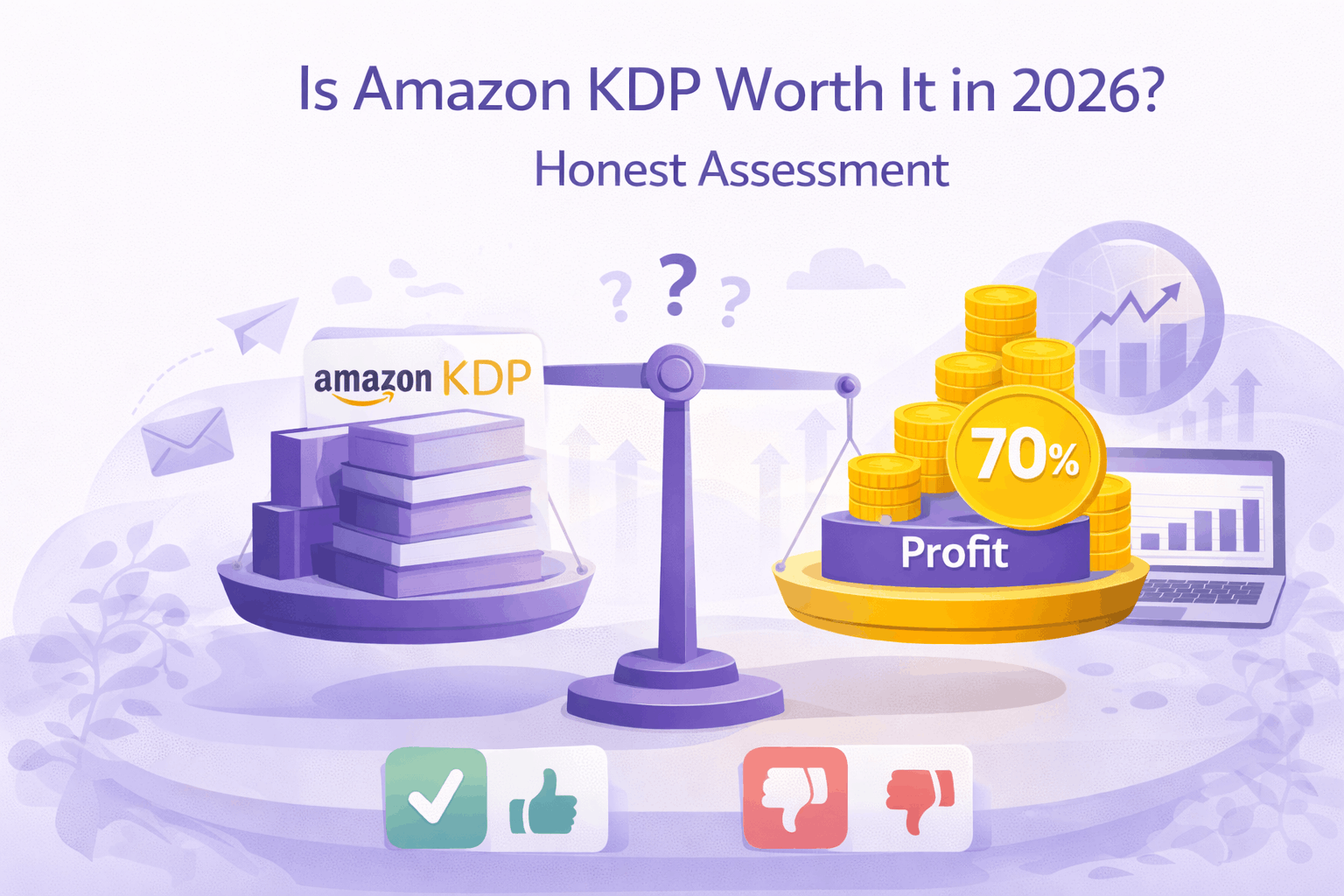
The $64,000 Question
Every aspiring author eventually asks: "Is Amazon KDP still worth it?"
It's a fair question. The platform launched in 2007. Millions of books have been published. The market looks crowded. AI tools have changed the game. The gurus keep making promises.
So let's answer this honestly—no hype, no affiliate links to courses, just data and real-world analysis from someone who's been in the self-publishing trenches.
The short answer: Yes, KDP is still worth it in 2026—but not for everyone, and not in the way most people think.
What's Actually Changed in 2026
Before we assess whether KDP is "worth it," we need to understand what's different now compared to even two years ago.
The AI Content Flood
The biggest shift in self-publishing has been AI-generated content. Since late 2022, the volume of books uploaded to KDP has exploded:
| Year | Estimated Books Published on KDP |
|---|---|
| 2020 | ~1.4 million |
| 2022 | ~2.3 million |
| 2024 | ~4.1 million |
| 2025 | ~5.8 million |
| 2026 | ~6.5+ million (projected) |
Much of this increase is low-quality, AI-generated content flooding niches like journals, planners, and short non-fiction.
What this means for you: Competition is higher, but most of it is noise. Quality still wins.
Amazon's Response to AI Content
Amazon has implemented stricter content policies:
- Disclosure requirements — Authors must disclose AI involvement in content creation
- Quality enforcement — More aggressive removal of low-quality and duplicate content
- Review scrutiny — Increased monitoring for fake reviews and manipulation
These changes actually help legitimate authors by reducing the garbage in the marketplace.
Reader Behavior Shifts
How readers discover and buy books has evolved:
- TikTok influence — BookTok continues driving sales, especially in romance, fantasy, and thrillers
- Kindle Unlimited dominance — KU now accounts for a significant portion of ebook consumption
- Audio growth — Audiobooks are growing faster than ebooks, but require additional investment
The Saturation Truth: What's Dead in 2026
Let's be blunt about what no longer works on KDP.
Low-Content Books (The Old Way)
The 2019-2021 gold rush of publishing basic lined journals and generic coloring books is over. Here's what happened:
What's dead:
- Generic "Dream Journal" or "Gratitude Notebook" with no unique angle
- Basic mandala coloring books
- Undifferentiated activity books
What still works:
- Highly niched journals (e.g., "IVF Treatment Tracker for Women Over 40")
- Professional-quality coloring books with unique art styles
- Interactive workbooks with genuine educational value
The bar has risen. If your low-content book could be replicated in 30 minutes by someone with Canva and ChatGPT, it won't sell.
👉 Explore our coloring book niche guide for profitable micro-niches that still work.
Short Non-Fiction Spam
The 20-page "books" on vague topics like "How to Be Happy" or "Productivity Tips" are essentially worthless now:
- Amazon's algorithm deprioritizes short content
- Readers leave 1-star reviews
- The category is oversaturated with AI garbage
If you're writing non-fiction, commit to creating genuinely valuable, comprehensive content.
Genre Fiction Without Series
Single-book authors in fiction face an uphill battle:
- No read-through revenue
- Algorithm doesn't favor one-book wonders
- Readers want series, especially in romance and fantasy
The economics only work when readers buy books 2, 3, and 4 after finding book 1.
What Still Works in 2026
Now for the good news. These approaches continue generating real income on KDP.
1. Series Fiction in Commercial Genres
Romance, thriller, mystery, fantasy, and sci-fi continue to dominate KDP. Authors with 5+ book series earn the majority of fiction income on the platform.
Why it works:
- High read-through (readers buy the whole series)
- Genre readers are voracious and loyal
- Kindle Unlimited page reads compound across books
The math: A 5-book romance series at $4.99 each with 40% read-through generates 2.6x the revenue of a single book at the same price.
2. Highly Niched Non-Fiction
Broad topics are dead. Micro-niches thrive:
| Saturated Topic | Profitable Niche |
|---|---|
| "Weight Loss" | "Keto Meal Prep for Night Shift Nurses" |
| "Starting a Business" | "Etsy Shop Setup for Handmade Jewelry Sellers" |
| "Self-Help" | "Confidence Building for Introverted Women in Tech" |
The narrower your audience, the easier it is to rank and the more you can charge.
3. Paperback + Hardcover Expansion
Ebook-only publishing leaves money on the table. In 2026:
- Paperback adds 30-40% to most authors' revenue
- Hardcover (now available on KDP) commands premium pricing
- Bundle pricing encourages readers to buy multiple formats
Use our KDP royalty calculator to see how format expansion affects your earnings.
4. Wide Distribution + KDP
Smart authors are no longer exclusively on Amazon:
- Draft2Digital for wide ebook distribution
- IngramSpark for expanded print reach
- KDP as the primary revenue engine
This reduces platform risk while maximizing discoverability.
Who Should Start Publishing on KDP in 2026
Based on real data and market conditions, here's who KDP makes sense for:
✅ You SHOULD Start If:
You're willing to commit for 2+ years KDP is not a quick money scheme. Authors who succeed publish consistently for years before seeing meaningful income. If you need money in 3 months, this isn't the path.
You enjoy writing (or managing writers) Publishing 1 book and hoping for passive income doesn't work. You need a catalog. That means either you love writing, or you can manage freelance writers and systems.
You're willing to learn the business side Cover design, keywords, categories, ads, blurbs—these matter as much as the writing. Authors who treat this like a business outperform those who just "want to be an author."
You have a specific genre or niche in mind "I'll write whatever sells" isn't a strategy. Success comes from understanding your reader deeply and serving them consistently.
You can self-fund the initial investment Expect to spend $500-$2,000 on your first book (cover, editing, formatting). This isn't optional if you want professional results.
❌ You Should NOT Start If:
You want passive income with no ongoing work The "publish once, earn forever" dream is largely dead. Even successful books require maintenance, updates, and marketing.
You're not willing to learn marketing Writing is maybe 40% of success. The rest is cover design, keywords, ads, and positioning. If you refuse to learn these, KDP will frustrate you.
You expect quick returns Most authors don't break even on their first book. If you can't afford to publish without immediate returns, wait until you can.
You're only interested because of YouTube hype The screenshots showing $10,000 months are real—for the top 1% after years of work. If you're starting because it looks easy, you'll quit in 6 months.
The Real Numbers: What You Can Expect
Let's ground this in actual mathematics.
First Year (Realistic Scenario)
| Metric | Conservative | Moderate | Aggressive |
|---|---|---|---|
| Books Published | 2 | 4 | 8 |
| Avg. Monthly Sales | 30 | 75 | 200 |
| Avg. Royalty/Sale | $2.50 | $3.00 | $3.50 |
| Monthly Revenue | $75 | $225 | $700 |
| Annual Revenue | $900 | $2,700 | $8,400 |
Most first-year authors fall somewhere between conservative and moderate.
Second Year (With Consistency)
| Metric | Conservative | Moderate | Aggressive |
|---|---|---|---|
| Total Books | 4 | 8 | 16 |
| Monthly Sales | 80 | 200 | 500 |
| Monthly Revenue | $200 | $600 | $1,750 |
| Annual Revenue | $2,400 | $7,200 | $21,000 |
The compound effect of backlist sales starts showing.
Year Three and Beyond
Authors who persist typically see:
- Conservative path: $300-$600/month
- Moderate path: $1,000-$2,000/month
- Aggressive path: $3,000-$7,000/month
The top 5% break into five figures monthly, but this usually requires 3-5 years and 20+ books.
👉 Calculate your specific earning potential here — plug in your actual book specs and price points.
The Investment Reality
Publishing isn't free. Here's what professional-quality publishing costs in 2026:
Per-Book Costs
| Expense | Budget | Professional |
|---|---|---|
| Cover Design | $50-$100 | $200-$500 |
| Editing | $100-$300 | $500-$1,500 |
| Formatting | $0-$50 | $50-$150 |
| Proofreading | $50-$100 | $150-$400 |
| Total | $200-$550 | $900-$2,550 |
Starting with a budget approach is fine, but expect lower results. As revenue grows, reinvest in professional quality.
Ongoing Costs
- Amazon Ads: $100-$500/month (optional but increasingly necessary)
- Software: $50-$150/month (writing tools, keyword research, design)
- Email Marketing: $0-$50/month (once you have readers)
How to Evaluate If It's Worth It FOR YOU
Here's a framework for your personal decision:
Step 1: Calculate Your Break-Even Point
Use our royalty calculator to determine:
- How much you'll earn per book sale
- How many sales you need to recover your investment
- Your monthly sales target for desired income
Step 2: Assess Your Time Investment
Realistic time requirements:
- Writing: 100-300 hours per book
- Publishing tasks: 20-40 hours per book
- Marketing: 5-10 hours per week ongoing
Annual commitment for 4 books: 500-1,500 hours
Divide your target annual income by hours invested. Is that hourly rate acceptable during the building phase?
Step 3: Consider Opportunity Cost
What else could you do with that time and money?
- A part-time job pays immediately
- Other side hustles may scale faster
- Investment in existing skills might yield better returns
KDP makes sense when you value the long-term asset you're building (a book catalog that earns for decades) over short-term income.
Step 4: Test Before Committing
Before going all-in:
- Publish one book as a learning experience
- Track every metric
- Analyze what worked and what didn't
- Decide if you enjoyed the process enough to continue
The Verdict: Is KDP Worth It in 2026?
Yes, if:
- You're building a long-term asset, not seeking quick cash
- You're willing to publish consistently for 2+ years
- You understand it's a business requiring marketing skills
- You have realistic expectations about timeline and income
- You're targeting specific, underserved niches
No, if:
- You need money in the next 6 months
- You want to publish one book and stop
- You're not willing to learn cover design, keywords, and ads
- You're entering because it looks easy
- You're not passionate about your topic or genre
The platform is more competitive than ever, but authors who treat this professionally still build meaningful income streams. The key difference from 2019: you can't phone it in anymore.
Quality, consistency, and business acumen matter more than ever.
Your Next Steps
If you've decided KDP is worth pursuing, start with data:
- Calculate your royalty potential — understand the math before publishing
- Estimate sales from BSR — learn what bestseller rank actually means
- Explore profitable niches — find underserved markets with demand
- Commit to your first book — but treat it as a learning experience, not a lottery ticket
The authors who win on KDP in 2026 are the ones who approach this with patience, professionalism, and realistic expectations. The platform still works—but only for those willing to do the work.
📊 Ready to run the numbers? Use our free KDP earnings calculator to see exactly what you could earn based on your book specs, price point, and realistic sales volume.
Frequently Asked Questions
Is Amazon KDP saturated in 2026?
Some niches are oversaturated (generic journals, broad self-help). However, micro-niches, series fiction, and high-quality content still have opportunities. The key is differentiation and professional execution.
Can you still make money with low-content books?
Yes, but only with highly niched, professional-quality products. Generic planners and basic coloring books are effectively dead. Focus on specific audiences with unique designs.
How long until I see income from KDP?
Most authors see their first sale within 1-4 weeks of publishing. Meaningful income ($500+/month) typically takes 12-24 months of consistent publishing.
Should I use KDP Select (Kindle Unlimited)?
For most fiction authors, yes—KU page reads often exceed ebook sales revenue. For non-fiction, test both approaches. You can change every 90 days.
Is it too late to start self-publishing?
No. While competition has increased, reader demand has also grown. Authors starting today with a professional approach can still build successful catalogs.
Do I need to spend money on Amazon Ads?
Not initially. Focus on organic discoverability first (keywords, categories, quality covers). Once you have data, ads can accelerate growth, but they're not mandatory.
Related Reading
- How Much Do KDP Authors Really Make?
- Best KDP Pricing Strategy for 2026
- How Amazon KDP Royalties Actually Work
- Profitable Coloring Book Niches
👉 Calculate your real Amazon KDP royalties here — our free calculator shows ebook, paperback & hardcover earnings instantly.
Topics
Ready to Run the Numbers?
Put this knowledge into action. Calculate your potential royalties before you publish.