
Best Pricing Strategy for Amazon KDP Books in 2025
Learn the optimal pricing strategies for KDP ebooks, paperbacks, and low-content books. Includes psychological pricing tactics and marketplace-specific advice.
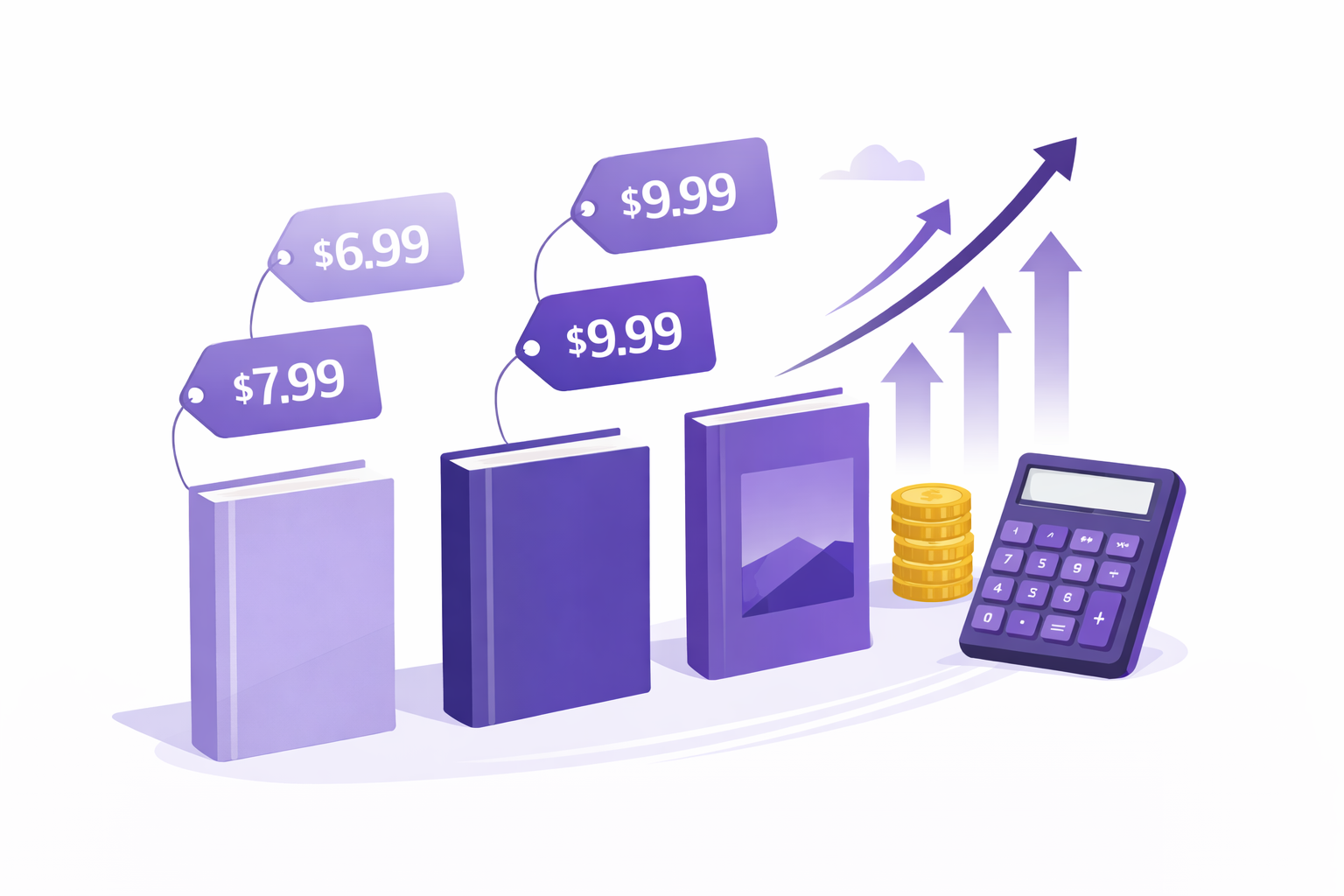
Your Book Price Is Make-or-Break
Here's something most new KDP authors don't realize: your pricing decision affects your royalties more than almost anything else you do.
Price too low? You leave money on the table with every sale.
Price too high? Browsers click away and buy the $4.99 book next to yours.
Get it right? You maximize both sales volume AND profit per book.
This guide breaks down exactly how to price your Amazon KDP books in 2025—whether you're publishing ebooks, paperbacks, low-content books, or building a fiction empire.
How Pricing Directly Affects Your Royalties
Before we talk strategy, you need to understand the math. Amazon offers different royalty rates, and your price determines which one you qualify for.
Ebook Royalty Tiers
70% Royalty Option:
- Available for prices between $2.99 and $9.99
- A delivery fee is deducted (based on file size)
- Best for most fiction and non-fiction ebooks
35% Royalty Option:
- Available at ANY price point
- No delivery fee
- Required if you price under $2.99 or over $9.99
Here's what this means in real money:
| Price | 70% Royalty | 35% Royalty |
|---|---|---|
| $0.99 | Not available | $0.35 |
| $2.99 | ~$1.94 | $1.05 |
| $4.99 | ~$3.34 | $1.75 |
| $6.99 | ~$4.74 | $2.45 |
| $9.99 | ~$6.69 | $3.50 |
| $12.99 | Not available | $4.55 |
The jump from $2.99 to $4.99 increases your royalty by 72%. That's $1.40 more per sale for adding just $2 to your price.
Paperback Royalty Structure
Paperbacks work differently. Amazon takes 40% off the top, then deducts printing costs:
Your Royalty = (List Price × 60%) - Printing Cost
For a 200-page black & white book:
- Printing cost: approximately $3.25
- At $9.99: ($9.99 × 0.60) - $3.25 = $2.74 royalty
- At $12.99: ($12.99 × 0.60) - $3.25 = $4.54 royalty
- At $14.99: ($14.99 × 0.60) - $3.25 = $5.74 royalty
The lesson: Small price increases create disproportionately larger royalties because printing costs stay fixed.
👉 Run your exact numbers with our KDP Royalty Calculator to see how pricing changes affect your earnings.
The Psychology of Book Pricing
Buyers don't make rational decisions. They make emotional ones, then justify them with logic. Smart pricing taps into this.
The Power of .99 Endings
You've seen this everywhere: $6.99 instead of $7.00. It works because:
- Left-digit effect: Brains process the "6" first and perceive $6.99 as closer to $6 than $7
- Familiarity: Shoppers expect .99 pricing and may distrust round numbers
- Perceived deal: The .99 signals you're offering the lowest possible price at that tier
Real data: Studies show .99 pricing can increase conversions by 8-15% compared to round numbers.
$6.99 vs $7.99: Which Wins?
Here's where it gets interesting. The "best" price depends on your goals:
$6.99 advantages:
- Stays in the "six-dollar" mental category
- Lower perceived barrier to purchase
- May sell 10-20% more units
$7.99 advantages:
- 70% royalty: $5.44 vs $4.74 (15% more per sale)
- Signals higher quality/value
- Better if you have strong reviews and cover
The math:
- At $6.99 selling 100 copies: $474 earnings
- At $7.99 selling 85 copies: $462 earnings
They're nearly identical. But if your book maintains 95% of sales volume at the higher price, you earn $517—9% more.
The $4.99 Sweet Spot
For ebooks in competitive genres, $4.99 often hits the sweet spot:
- Low enough to be an impulse purchase
- High enough for a respectable $3.34 royalty
- Psychologically below "five dollars"
- Works well for series starters and first-in-genre books
When Premium Pricing Works
Some authors successfully price at $7.99-$9.99:
- Established series with loyal readers
- Non-fiction with specific, valuable information
- High-production books with professional covers and editing
- Niche topics with limited competition
Premium pricing fails when:
- You're a new author with no reviews
- Your cover looks amateur
- Competition prices significantly lower
- You're in a price-sensitive genre
Low-Content Book Pricing Strategy
Journals, planners, coloring books, and activity books follow different rules.
Coloring Books: The $6.99-$9.99 Range
Most successful coloring books price between $6.99 and $9.99:
Budget tier ($6.99-$7.99):
- Attracts price-sensitive buyers
- Works for simpler designs or shorter books
- Good for building initial reviews
Standard tier ($8.99-$9.99):
- Where most competition lives
- Signals quality without premium positioning
- Balances volume with royalty
Premium tier ($10.99-$14.99):
- Requires exceptional design quality
- Thick page count (80+ designs)
- Strong brand or niche authority
Journals and Planners: Price by Page Count
Buyers judge journals partly by thickness:
| Page Count | Suggested Price Range |
|---|---|
| 100-120 pages | $5.99-$7.99 |
| 150-180 pages | $8.99-$11.99 |
| 200+ pages | $12.99-$17.99 |
Tip: Your printing costs increase with pages, so longer books NEED higher prices to maintain margins.
Activity Books: Consider Your Audience
Kids' activity books often price lower ($5.99-$8.99) because:
- Parents buy in volume
- They're "consumable" products
- Competition from dollar stores
Adult activity books (puzzles, brain games) can price higher ($9.99-$14.99) because buyers perceive more value.
👉 See exactly how page count affects your profits with our calculator.
Fiction Pricing by Genre and Strategy
Fiction pricing varies dramatically by genre and author status.
Genre Expectations
Romance:
- Novellas: $0.99-$2.99
- Full novels: $3.99-$5.99
- Established authors: $5.99-$7.99
- Price sensitivity is HIGH in this genre
Thriller/Mystery:
- Entry: $2.99-$4.99
- Standard: $4.99-$6.99
- Premium: $7.99-$9.99
- Readers expect deals on first-in-series
Science Fiction/Fantasy:
- Longer books justify higher prices
- $4.99-$7.99 is typical
- Epic fantasy can push $8.99-$9.99
Literary Fiction:
- Broader price acceptance
- $5.99-$9.99 common
- Quality perception matters more
Series Pricing Strategy
The most profitable fiction strategy:
- Book 1: $2.99 or $3.99 (low barrier)
- Book 2: $4.99 (readers are hooked)
- Book 3+: $5.99-$6.99 (loyal readers pay more)
Some authors price Book 1 at $0.99 permanently as a "loss leader." This can work if:
- You have 3+ books in the series
- Read-through rate is 50%+
- Later books are priced at $4.99+
Warning: Don't do this with a single book. You'll just earn $0.35 per sale with nowhere to recoup.
Global Marketplace Pricing Differences
Amazon operates separate marketplaces with different currencies and buyer expectations.
Key Marketplaces
United States (amazon.com):
- Your primary market (typically 60-70% of sales)
- Price in USD as your baseline
United Kingdom (amazon.co.uk):
- Second largest English market
- Price 10-20% lower than USD equivalent
- £4.99 often outperforms £5.99
Germany (amazon.de):
- Largest European marketplace
- €4.99-€6.99 for most ebooks
- Strong non-fiction market
Canada (amazon.ca):
- Similar to US expectations
- CAD prices should feel proportional
Currency Conversion Strategy
Option 1: Let Amazon Convert
- Amazon automatically sets prices based on exchange rates
- Simple but not optimized
- May create odd prices like £4.23
Option 2: Set Manual Prices
- Choose round .99 prices in each currency
- Better buyer experience
- Requires periodic review
Best practice: Manually set prices for your top 4-5 marketplaces. Let Amazon handle the rest.
Expanded Distribution Pricing
If you use Expanded Distribution for paperbacks (selling through other retailers):
- You only earn 40% royalty (not 60%)
- Price higher to maintain margins
- Many authors skip expanded distribution for low-content books
Test Your Book Price Using Our KDP Pricing Calculator
Before you publish—or if you're considering a price change—run the numbers.
Step-by-Step: Finding Your Optimal Price
Step 1: Calculate Your Base Costs
For paperbacks, you need to know your printing cost first. This varies by:
- Page count
- Interior (black & white vs color)
- Trim size
Use our KDP Royalty Calculator to find your exact printing cost.
Step 2: Calculate Minimum Viable Price
Your minimum price = Printing Cost ÷ 0.60
For a book with $3.50 printing cost:
- Minimum price = $3.50 ÷ 0.60 = $5.83
- Round up to $5.99 or $6.99
Step 3: Compare Price Points
Run calculations at multiple prices:
| Price | Royalty | Monthly (10 sales/day) |
|---|---|---|
| $6.99 | $0.69 | $207 |
| $8.99 | $1.89 | $567 |
| $10.99 | $3.09 | $927 |
| $12.99 | $4.29 | $1,287 |
Step 4: Research Competition
Search your target keywords on Amazon:
- What do the top 10 results charge?
- Where do bestsellers cluster?
- Are there gaps in pricing you can fill?
Step 5: Test and Adjust
After publishing:
- Track sales for 2-4 weeks at your initial price
- Try raising price by $1-2
- Compare conversion rates
- Find your optimal point
Real Pricing Example: Coloring Book
Let's price a 50-page adult coloring book:
Costs:
- Printing: ~$2.15 (6×9, black interior, white paper)
- Minimum viable: $2.15 ÷ 0.60 = $3.58
Competition research:
- Similar books: $5.99-$8.99
- Bestsellers: $6.99-$7.99
Decision matrix:
| Price | Royalty | vs Competition |
|---|---|---|
| $5.99 | $1.44 | Cheapest option |
| $6.99 | $2.04 | Competitive |
| $7.99 | $2.64 | Mid-market |
| $8.99 | $3.24 | Premium positioning |
Recommendation: Start at $7.99 with a quality cover. If sales are slow after 30 days, drop to $6.99.
👉 Calculate your book's royalties at different price points
Common Pricing Mistakes (And How to Avoid Them)
Mistake #1: Racing to the Bottom
New authors often think: "I'll price at $0.99 to get sales and reviews!"
Why this fails:
- You earn just $0.35 per sale
- Low prices signal low quality
- No margin for advertising
- You attract bargain hunters, not loyal readers
Better approach: Price competitively but not desperately. A quality $4.99 book outsells a suspicious $0.99 book.
Mistake #2: Ignoring Printing Costs
Authors price paperbacks without calculating costs first.
Example disaster:
- 300-page book priced at $8.99
- Printing cost: $5.20
- Royalty: ($8.99 × 0.60) - $5.20 = -$0.81
You'd LOSE money on every sale.
Solution: Always calculate printing cost first. Then price for at least $2+ royalty.
Mistake #3: Setting and Forgetting
Your optimal price changes over time:
- After accumulating reviews, raise prices
- Seasonal adjustments (Q4 price increases)
- Genre trends shift
- Competition changes
Best practice: Review pricing quarterly.
Mistake #4: Same Price for Ebook and Paperback
Your ebook and paperback serve different buyers:
- Ebook: Convenience, immediate, lower cost
- Paperback: Physical ownership, gift-giving, permanence
Typical ratio: Paperback priced 50-100% higher than ebook
Example:
- Ebook: $4.99
- Paperback: $9.99-$12.99
Mistake #5: Ignoring Marketplace Differences
$9.99 feels different in different countries:
- USA: Reasonable ebook price
- India: Premium/expensive
- Germany: Standard
Tailor prices to local purchasing power when possible.
Your KDP Pricing Checklist for 2025
Before publishing, run through this checklist:
Pre-Launch Pricing Checklist
- Calculated printing cost (for paperbacks)
- Confirmed price qualifies for 70% royalty (ebooks $2.99-$9.99)
- Researched competitor pricing (top 10 in your category)
- Set .99 price endings in all major marketplaces
- Ensured $2+ royalty minimum for paperbacks
- Priced ebook 40-50% below paperback
- Tested calculations with KDP Royalty Calculator
Post-Launch Price Optimization
- Track conversion rate for first 30 days
- A/B test with $1 price increase after initial period
- Adjust for seasonality (raise in Q4)
- Increase prices after hitting 50+ reviews
- Review and update prices quarterly
Red Flags to Watch
- Royalty under $1 per sale = reconsider your pricing
- Price significantly below competition = leaving money behind
- Price significantly above competition without justification = limiting sales
- Paperback cheaper than ebook = confusing to buyers
What Successful KDP Authors Do Differently
Authors earning $1,000+ monthly with pricing:
- They calculate first, price second — never guess
- They test prices — treat it as an experiment
- They price for profit — not just volume
- They adjust over time — pricing is ongoing
- They study their genre — know what buyers expect
Your price is not permanent. It's a lever you can pull to optimize your publishing business.
Start with the math. Use our Amazon KDP Royalty Calculator to find your optimal price point before you publish.
Topics
Ready to Run the Numbers?
Put this knowledge into action. Calculate your potential royalties before you publish.